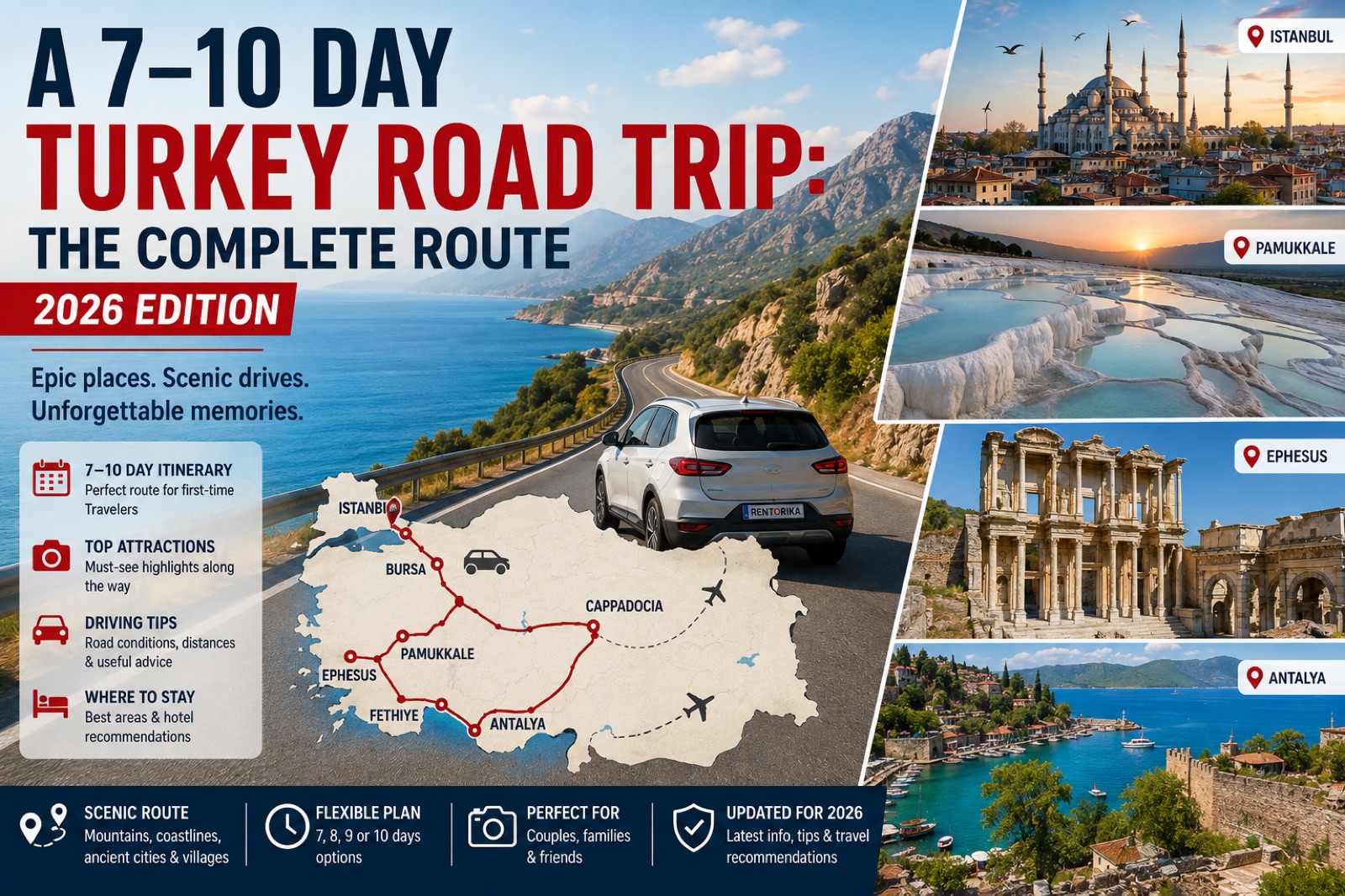
A 7–10 Day Turkey Road Trip: The Complete Route (2026 Edition)
Turkey rewards a driver more generously than almost any Mediterranean country still relatively affordable to explore this way. The route below strings together ancient ruins, sunken cities, a valley you can only reach by foot or car, and a coastline that shifts from pine forest to travertine terrace over the course of a single week — all reachable without ever needing to book a domestic flight or wait for a bus timetable that doesn't match your plans. This is the same route this platform's Antalya, Fethiye, and coastal city guides all point back toward, written out in full, day by day, updated for how things actually stand in August 2026.
Find a car
Prices and availability from local companies — instantly, no enquiries
A Quick Safety Note Before the Route
Every stop on this itinerary sits in western, central, and southern Turkey — the Turquoise Coast, the Aegean, and the Denizli region — all part of the country's well-established, fully functional tourism infrastructure that tens of millions of visitors pass through every year without incident. As of August 2026, official travel advisories from the US, UK, and other governments continue to flag southeastern Turkey, specifically areas within roughly 10 kilometers of the Syrian and Iraqi borders, due to regional conflict spillover — this route never comes close to that region, and Istanbul, Cappadocia, Antalya, Fethiye, and Pamukkale all continue to operate normally as major, well-policed tourist destinations. It's still worth checking your own government's current advisory before you travel, simply because conditions in border regions can shift, but nothing about that situation should discourage this specific itinerary.
For context on the geography involved: the nearest point on this entire itinerary to any flagged border region is still several hundred kilometers away — Antalya to the Syrian border alone is a longer drive than this entire route covers end to end. This isn't a route that requires any special border-region planning or contingency thinking; it's included here for completeness and because a responsible, currently accurate guide shouldn't simply omit the topic, not because there's a meaningful overlap between this itinerary and any area of active concern.
How This Route Works: 7 Days vs. 10 Days
This itinerary is built as a 10-day core route along the Turquoise Coast with a Pamukkale extension, and it compresses cleanly into 7 days by dropping the Pamukkale leg and tightening a couple of the coastal stops — both versions are mapped out below, so pick whichever matches your actual dates rather than trying to force one itinerary to fit either length.
The route is designed as a loop-and-return from Antalya rather than a strict point-to-point drive, meaning both versions bring you back to (or near) your starting airport, simplifying rental logistics considerably compared to a route requiring a one-way drop-off — though as covered later in this guide, one-way extensions toward Bodrum or Cappadocia remain genuinely worthwhile options if your schedule and budget accommodate the extra fee.
The 7-day version stays entirely on the coast: Antalya to Fethiye, taking in Olympos, Kas, Kalkan, Patara, and the Saklikent Gorge, finishing at Oludeniz's blue lagoon — a tightly packed but genuinely unrushed week if you don't try to add extra stops on top of it.
The 10-day version adds a return loop through Pamukkale's travertine terraces and the ancient city of Hierapolis, plus an extra buffer day, before either looping back to Antalya or flying out from a more convenient airport near Denizli — worth the extra three days if this is likely your only trip to Turkey for a while, since Pamukkale is genuinely unlike anywhere else on the coastal route.
Neither version requires advance decisions about every single stop before you leave home — the itinerary below is deliberately built with enough flexibility that skipping or extending any individual day doesn't unravel the rest of the plan, which matters in practice since weather, energy levels, and simply falling in love with one particular town are all genuinely common reasons this exact route ends up adjusted slightly once travelers are actually on it.
Before You Set Off: Three Things Worth Confirming First
This guide assumes you've already sorted the basics covered in this platform's other Turkey guides — worth a quick check before day one if you haven't already:
- Your license, IDP if needed, and the credit card for your deposit are all in order
- You know the current HGS toll mechanics, since this route does cross a few tolled sections
- You understand the 2026 speed limit and fine structure, since several stretches of this route pass through small towns where the urban limit drops sharply and enforcement is active
What to Pack Specifically for This Route
Beyond standard warm-weather travel packing, a handful of items are worth bringing specifically because of what this exact itinerary involves. Closed-toe walking shoes matter for the Chimera's rocky path, the Lycian tombs' uneven terrain, and Saklikent Gorge's riverbed walk — sandals work for beach days but genuinely don't for at least three separate stops on this route. Water shoes or old sneakers you don't mind soaking are close to essential for Saklikent Gorge specifically, since you're wading directly through cold running water, not just viewing it from a bank. A basic first-aid kit and reusable water bottles are worth keeping in the car throughout, given how much of this itinerary involves walking in direct sun with limited shade at several ancient sites. A phone mount for the car, covered in more detail in this platform's traffic rules guide, matters here as much as anywhere else in Turkey — several of these driving legs involve winding coastal roads where handling a phone for directions is both illegal and genuinely more dangerous than on a straight highway.
Which Car Class Actually Makes Sense for This Route
Every stop on this itinerary is reachable on paved roads by a standard economy or compact rental, but a few practical factors are worth weighing before defaulting to the cheapest available class. A compact or mid-size sedan handles the winding coastal sections between Kemer and Kas noticeably more comfortably than the smallest economy class, particularly if you're prone to motion sensitivity on curving roads — worth the modest price step up if that's a concern for anyone in your group. Trunk space matters more on this route than a typical city-based rental, since you're living out of the car for a full week or more with luggage for every stop; an economy hatchback with a genuinely small boot can feel cramped by day four if you're traveling as a couple with full-size suitcases rather than backpacks. For a family of four with the associated luggage, a mid-size sedan or small SUV is generally worth the incremental daily cost over squeezing into an economy class built more for solo city driving than a multi-stop road trip.
Who This Route Suits (and Who It Doesn't)
This itinerary rewards travelers who genuinely enjoy the process of a road trip — stopping when something looks interesting, adjusting a day's plan based on weather or energy levels, and accepting that a "quick stop" often runs longer than planned. It suits couples, small families with kids old enough to handle a moderate amount of walking at ruins sites, and groups of friends splitting the driving across the week.
It suits this profile less well: travelers who strongly prefer a fixed, fully organized schedule with zero ambiguity, anyone uncomfortable with the idea of driving unfamiliar coastal roads (even though, as covered in the driving notes above, the roads themselves are genuinely manageable), and travelers on a very tight timeline who'd rather see fewer things thoroughly than cover this much ground. For that last group specifically, picking three or four stops from this itinerary and basing a shorter trip around just those, rather than attempting the full route compressed into fewer days, generally produces a more satisfying trip than rushing the whole thing.
Solo travelers are also well served by this route, worth noting explicitly since road trips sometimes get framed as inherently couple- or family-oriented — every stop described here is genuinely enjoyable and safe to explore alone, accommodation options across every town on the route include comfortable single-occupancy choices, and the flexibility of a self-driven itinerary arguably suits solo travel even better than group travel, since there's no need to negotiate pace or preferences with anyone else along the way.
How This Compares to a Guided Multi-Day Tour of the Same Region
Organized tours covering a similar stretch of coastline exist and are a legitimate alternative, particularly for solo travelers or anyone uncomfortable driving abroad — but they come with real trade-offs against the self-driven version of this route. A guided tour runs on a fixed group schedule, meaning if Saklikent Gorge is exactly as refreshing as this guide describes and you'd like another hour there, the group itinerary doesn't accommodate that. A self-driven version also lets you skip a stop entirely if it doesn't appeal once you're there, rebase overnight stays around how a day actually went rather than a pre-booked hotel chain, and generally costs less per day once you account for what a multi-day guided package charges for transport, guiding, and fixed-itinerary hotels bundled together. The genuine advantage of a guided tour is not needing to drive yourself and having a local guide's context at each site — for travelers who value that specifically over flexibility and cost, it's a reasonable alternative, though not the focus of this guide.
Day 1: Arrive and Settle Into Antalya
Land at Antalya Airport (AYT), pick up your car, and resist the urge to drive anywhere far on day one — jet lag and an unfamiliar rental combine badly with an ambitious first-day itinerary. Spend the afternoon in Kaleici, Antalya's old town: narrow Ottoman-era streets, the Hadrian's Gate, and a harbor that's genuinely pleasant to walk at sunset. If you have energy left, the Duden Waterfalls sit a short drive from the city center and make an easy, low-effort first outing in the rental car before tomorrow's longer drive begins.
For dinner, Kaleici's restaurant density means you're never far from a decent meal, though the streets directly on the harbor tend to run a tourist premium — walking two or three blocks inland from the water generally finds the same quality of grilled fish and mezze at a noticeably better price, a pattern that holds true across most of the coastal towns on this route, worth remembering for the rest of the trip.
Overnight: Antalya (old town or a hotel near the harbor)
Day 2: Antalya to Olympos and Cirali, via Phaselis
Leave Antalya heading southwest along the coastal road toward Kemer — around 45 minutes — and stop at the ancient ruins of Phaselis, a genuinely underrated site where Roman-era ruins sit directly against a pine-forest beach, quiet enough most mornings that it doesn't feel like a checklist stop. Continue on to Olympos and its neighboring village Cirali, roughly another hour further, where the ancient city ruins spill directly onto a long, undeveloped beach backed by mountains — one of the few stretches of the Turkish coast that's stayed genuinely low-key rather than fully resort-developed.
Phaselis specifically rewards an early arrival — it's a working archaeological site without the extensive tourist infrastructure of the region's larger ruins, meaning the mid-morning hours before larger tour groups arrive are genuinely the best time to walk the site's three small harbors and the tree-lined main street connecting them. The beach directly beside the ruins is a legitimate swimming stop, not just a viewing platform, and packing a swimsuit for this specific stop rather than waiting until Olympos is worth doing.
In the evening, drive the short, winding road up to the Chimera (Yanartas) — natural gas flames that have burned continuously out of bare rock for as long as recorded history, a genuinely strange and worthwhile short hike best timed for dusk, when the flames are easiest to see against the darkening sky.
The walk up to the Chimera takes around 20–30 minutes on a clearly marked but uneven rocky path — closed-toe shoes matter more here than at almost any other stop on this route, and a flashlight or phone light for the walk back down after dark is genuinely useful rather than optional, since the path isn't lit.
Drive time: roughly 1.5–2 hours total, with stops
Overnight: Cirali or Olympos (treehouse-style bungalow accommodation is a local specialty here worth trying at least once)
A Note on Connectivity and Navigation Along This Route
Mobile coverage along the entire coastal stretch of this itinerary is reliable — every stop from Antalya through Fethiye sits within range of standard 4G/5G coverage, and the Pamukkale extension inland is similarly well covered. Standard navigation apps work without issue for the whole route, and an eSIM or local prepaid SIM activated on arrival, covered in more detail in this platform's fuel-and-parking guide, is the simplest way to have reliable data throughout rather than relying on hotel wifi to plan each day's driving. The one stretch worth downloading an offline map region for as a backup, purely out of caution rather than genuine necessity, is the inland Fethiye-to-Pamukkale leg, where the road briefly passes through less densely populated terrain than the coastal sections.
Day 3: Olympos to Demre (Myra) to Kas
Head further southwest to Demre, home to the rock-cut Lycian tombs carved directly into a cliff face above the modern town, and the Church of St. Nicholas — yes, that St. Nicholas, whose historical basis as Bishop of Myra sits right here, centuries before any Santa Claus mythology existed. Give this an hour or two, then continue on to Kas, a genuinely charming small harbor town that's become a base for the whole southern stretch of this route.
Demre itself, beyond the two headline sites, is a working town built around greenhouse agriculture — tomatoes, mostly — rather than a resort destination, which means it's an easy, unpretentious lunch stop without the tourist-town pricing found elsewhere on this route. It's worth timing your visit to the tombs for mid-morning rather than midday, since the cliff face they're carved into faces the sun directly by early afternoon, making both the viewing and any photography considerably harder in the heat and glare.
Drive time: roughly 1.5 hours total, with the Demre stop
Overnight: Kas (two nights, since day 4 stays local)
Traveling With Kids: Notes for Days 1–3 Specifically
Families doing this route with children generally find the first three days the easiest to adapt — Antalya's old town is stroller-manageable in most sections, Phaselis and Olympos both combine ruins with an actual beach kids can play on immediately afterward, and the Chimera hike, while rocky, is short enough for most kids over about six to manage with a hand held on the uneven sections. The main adjustment worth making: treat the Chimera as an early-evening outing rather than pushing it later into full darkness with tired kids on an unlit path, and build in more downtime at Cirali's beach than the itinerary above suggests, since it's genuinely one of the best kid-friendly stops on the whole route and rushing past it undersells it.
Day 4: Kas — Kekova, Simena, and a Slower Day
Kas earns a full day without driving anywhere. Book a boat trip out to Kekova island, where a section of an ancient city sits partially submerged beneath clear water following an ancient earthquake — visible from the boat, not accessible for swimming over the ruins themselves, but a genuinely unusual sight regardless. The same trip typically continues to Simena (Kalekoy), a tiny village beneath a hilltop castle, reachable only by boat or a long hike, with lunch options right on the water.
Most Kekova boat trips run as a full-day excursion, typically departing Kas harbor mid-morning and returning by early evening, with swimming stops in clear coves along the way in addition to the sunken city viewing and the Simena stop — worth confirming exactly what's included when booking, since trip length and stops vary somewhat between operators. Smaller group or private boat options exist alongside the larger standard tours, generally at a higher price but with more flexibility over timing and stops if that appeals more than a fixed group schedule.
If you'd rather stay on land, Kas town itself rewards a slow day — a proper harbor, good diving and snorkeling directly off small coves nearby, and a noticeably less package-tourism feel than several other coastal towns on this route.
A Note on Regional Food Along This Stretch
This section of the Turquoise Coast has its own distinct food identity worth seeking out deliberately rather than defaulting to whatever's nearest the harbor. Look for tarhana soup (a fermented grain-and-yogurt base, genuinely different from anything else on a standard Turkish menu), gozleme made fresh at small roadside stands rather than restaurant menus, and — specifically around Kas and Kalkan — a noticeably heavier Greek-influenced mezze tradition than you'll find further east on this route, a legacy of the region's pre-1923 mixed population. Fresh-caught fish, priced by weight and grilled simply, is reliably good anywhere directly on a harbor in this region, though it runs at a genuine premium compared to inland meals — worth budgeting for at least once or twice across the week rather than every night if cost matters to your trip.
Day 5: Kas to Kalkan to Patara
A short, relaxed driving day. Kalkan sits barely 30 minutes from Kas, a steep, whitewashed harbor town that's developed more upmarket than its neighbor but retains real charm in its old quarter — worth an hour or two wandering before continuing on.
Kalkan's steep, stepped streets are worth knowing about in advance if mobility is a concern for anyone in your group — the old town center is built up a genuinely steep hillside from the harbor, charming to walk but not flat, unlike the more level layout of Kas.
From Kalkan, the drive to Patara takes another 20–30 minutes, where one of Turkey's longest and least developed beaches — roughly 18 kilometers of sand — sits directly beside the extensive ruins of ancient Patara, a former major Lycian port city now largely excavated and open to wander through on the way to the beach itself. Combine both in one visit: ruins in the morning before the heat sets in, beach in the afternoon.
Patara's beach is also a protected nesting site for loggerhead sea turtles during summer months, and roped-off sections marking active nests are common — worth respecting these boundaries strictly rather than treating them as casual suggestions, both because it's the law and because it's one of the few remaining nesting beaches of its kind on this coastline.
Drive time: under an hour total
Overnight: Kalkan or Patara area
Day 6: Xanthos, Letoon, and Saklikent Gorge, Toward Fethiye
A day built around three distinct stops on the way to Fethiye. Xanthos, a short detour inland from the coastal road, was once the capital of ancient Lycia and holds some of the region's most significant ruins, including inscribed pillar tombs found nowhere else in this concentration. Letoon, close by, adds a well-preserved sanctuary site — both together take under two hours if you're not lingering extensively.
Xanthos in particular carries weight beyond its ruins: it was the site of two mass self-destructions by its own citizens rather than surrender, first to the Persians and later to the Romans, an episode ancient historians recorded with genuine astonishment at the time — worth knowing before you walk the site, since it reframes what might otherwise read as a fairly standard set of column fragments and foundations into something considerably more resonant. Letoon's sanctuary, dedicated to Leto and her children Apollo and Artemis, functioned as Lycia's federal religious center, distinct from Xanthos's role as its political capital — the two sites are best understood as a paired visit rather than two unrelated stops that happen to sit near each other.
Xanthos carries a genuinely dramatic history worth knowing before you arrive: the city's inhabitants are recorded as having twice chosen mass self-destruction — burning their own city and taking their own lives — rather than surrender to besieging armies, first against the Persians and centuries later against Rome's Brutus. Walking the site with that context in mind adds a weight to the ruins that a passing glance at the inscriptions alone doesn't convey. Letoon, by contrast, was never a city but a sanctuary complex dedicated to Leto and her children Apollo and Artemis, and its three adjacent temples remain some of the best-preserved religious architecture from this specific period of Lycian history.
The genuine highlight of the day is Saklikent Gorge, a narrow limestone canyon you wade and walk directly through cold running water, cutting deep into the mountains — bring water shoes or old sneakers you don't mind getting wet, since this isn't a viewpoint-and-photo stop, it's a physical walk into the gorge itself.
The water at Saklikent runs genuinely cold year-round, fed by snowmelt even in the height of summer, which makes it one of the most refreshing stops on the entire route during a hot August afternoon, but also means younger children or anyone sensitive to cold water may want to keep the walk shorter rather than pushing deep into the canyon. A small restaurant complex sits at the gorge's entrance, built partially over the river itself, and makes a genuinely pleasant lunch stop before continuing to Fethiye.
More on Xanthos and Letoon Specifically
Xanthos rewards visitors who take the time to actually read the site information rather than walking through quickly — its pillar tombs, inscribed in the now-extinct Lycian language alongside Greek, represent one of the only substantial written records of that language anywhere in the world, and the site's acropolis offers a genuinely sweeping view over the Xanthos valley below. Letoon, a short drive away, centers on a sanctuary dedicated to Leto and her children Apollo and Artemis according to Lycian mythology, with three adjoining temples and a well-preserved theater — smaller in scale than Xanthos but no less significant historically, and rarely crowded even in peak season given how few visitors make the short detour required to reach it.
Finish the drive into Fethiye by early evening.
Drive time: roughly 2–2.5 hours total, including all stops
Overnight: Fethiye
Day 7: Fethiye, Oludeniz, and Kayakoy
The final day of the 7-day version, or a mid-trip day if you're continuing to Pamukkale. Oludeniz's blue lagoon, a short drive from Fethiye, is exactly as photogenic in person as in every photo you've seen of it — arrive early if you want the beach itself without a significant crowd, since it's deservedly popular by midday. Babadag mountain above the lagoon is one of the world's best-known paragliding launch points, worth booking in advance if you want to add a tandem flight over the coastline to the day.
In the afternoon, Kayakoy — a Greek village abandoned during the 1923 population exchange between Greece and Turkey and never resettled — sits a short drive away, hundreds of stone houses and two churches left standing empty on a hillside, genuinely haunting and unlike anything else on this route.
Fethiye town itself, often treated purely as a base for Oludeniz and Kayakoy, deserves at least a couple of hours in its own right — a lively Tuesday market (if your dates align), rock tombs of its own cut into the cliffs directly above the town center, and a genuinely good fish market and adjoining restaurants where you select your own fish and have it grilled to order, one of the more memorable meals on this entire route for travelers who enjoy that kind of hands-on dining experience.
If this is your final day: return the rental car in Fethiye or drive back to Antalya for drop-off, depending on your rental's terms — check one-way fees in advance if your plan is to drop off somewhere other than where you picked up, as covered in this platform's full cost guide.
Driving Notes Specific to This Route
The coastal road connecting most of these stops (the D400) is generally well maintained and clearly signed, but it winds considerably along cliff-hugging sections, particularly between Kemer and Kas — a genuinely scenic drive, but not one to rush, and not the stretch of this itinerary to attempt tired or after dark if you can help it. Speed limits drop sharply through the many small villages this road passes through, and as covered in this platform's traffic rules guide, enforcement on exactly this kind of tourist-heavy coastal corridor is active, particularly in peak season.
Parking at each stop generally follows the pattern described in this platform's fuel-and-parking guide: paid otopark lots near the more developed sites (Pamukkale, Kas town center, Oludeniz), informal or free parking at the smaller, less-visited stops (Saklikent, Xanthos, the Chimera trailhead). Arriving at popular stops — Saklikent Gorge and Oludeniz beach specifically — before mid-morning in peak season avoids both the worst of the parking competition and the heaviest crowds at the site itself.
Fuel stops are plentiful along the entire coastal stretch, and this route never involves the kind of remote, gas-station-scarce driving that requires special planning — the only genuine consideration is topping up before the Fethiye-to-Pamukkale inland leg, since stations thin out somewhat once you leave the coastal road.
Days 8–10: The Pamukkale Extension
For the 10-day version, continue inland from Fethiye rather than ending the trip here.
Day 8: Fethiye to Pamukkale
A longer driving day — roughly 4 to 4.5 hours covering around 250 kilometers, heading inland and north toward Denizli province. Break the drive if you'd like with a stop in the town of Tlos, another Lycian site with a dramatic hillside setting, though this adds meaningful time and is easy to skip if you'd rather arrive in Pamukkale with energy left for the afternoon. Arrive in Pamukkale by mid-afternoon and, if the light and your energy allow, walk a first loop of the lower travertine terraces before the site closes for the evening.
This is the longest single driving leg of the entire itinerary, and it's worth treating accordingly — a proper breakfast before setting off, a planned lunch stop roughly at the halfway point rather than pushing straight through, and realistic expectations that this is primarily a travel day rather than a sightseeing-heavy one. The road itself is well maintained throughout, transitioning from coastal terrain to a more open, agricultural inland landscape as you approach Denizli province.
Drive time: 4–4.5 hours
Overnight: Pamukkale village
Day 9: Pamukkale and Hierapolis, Full Day
Give this a full day rather than rushing it. The combined Pamukkale and Hierapolis entrance ticket runs €30 per adult as of current 2026 pricing, covering both the white travertine terraces themselves and the extensive ancient city ruins above them, including a well-preserved Roman theater and a genuinely excellent on-site archaeology museum housed inside restored Roman baths. Swimming in Cleopatra's Antique Pool costs an additional €6 and is worth it — thermal water, submerged ancient columns, and a genuinely unusual place to swim, though note that the pool underwent a maintenance closure earlier in 2026, so it's worth a quick check that it's confirmed reopened before you specifically plan around swimming there.
A useful budget note for travelers combining several paid sites on this route: Turkey's regional museum passes can be worth it if you're visiting five or more paid sites across a region — the Aegean Pass and Mediterranean Pass each cover a cluster of sites including Pamukkale, and pencil out favorably against buying individual tickets once your itinerary includes enough stops. Worth checking official current pricing before you commit to one, since coverage and cost shift periodically.
More on Hierapolis Specifically
Hierapolis, the ancient city sitting directly above Pamukkale's travertine terraces, deserves more time than the quick pass-through many day-trippers give it. Beyond the Roman theater and the archaeology museum already mentioned, the site includes an extensive necropolis — one of the largest and best-preserved in Asia Minor, with hundreds of tombs spanning several centuries of continuous use, spread across a genuinely large area worth a dedicated hour of walking rather than a five-minute glance from the main path. The site's sacred pool area, distinct from the more famous Cleopatra's Pool, and the remains of a Plutonium (an ancient site associated with toxic underground gas, tied to Hierapolis's historical reputation as a "gateway to the underworld") add a layer of genuine historical strangeness that a rushed visit misses entirely. Budgeting a full day for Pamukkale and Hierapolis together, as this itinerary does, rather than the half-day many tour packages allocate, is specifically what allows for this deeper exploration.
Overnight: Pamukkale village
A Short Glossary of Lycian and Regional History Terms
A handful of terms come up repeatedly across this route's ancient sites, and a basic grasp of them adds real context to what you're looking at.
- Lycia — the ancient region covering most of this route's southern coastal stretch, a loose confederation of city-states with a distinct culture and language predating full Roman absorption, known especially for its rock-cut tombs and its early, sophisticated federal political system.
- Lycian tombs — the distinctive rock-cut or free-standing pillar tombs found at Myra, Xanthos, and several smaller sites along this route, carved directly into cliff faces or standing as monuments, often imitating wooden house architecture in stone.
- Necropolis — literally "city of the dead," the term used for the large tomb complexes found at several of these sites, distinct from the residential and civic ruins nearby.
- Agora — the central public gathering and marketplace space in a Greco-Roman city, present in some form at most of the larger ruin sites on this route.
- Population exchange (1923) — the forced relocation of Greek Orthodox and Muslim populations between Greece and Turkey following the Treaty of Lausanne, the direct historical cause of Kayakoy's abandonment and a pattern repeated in several smaller villages across this region.
Day 10: Pamukkale Back to Antalya (or Onward)
The return drive from Pamukkale to Antalya runs roughly 3.5 to 4 hours via the most direct route, making a comfortable single travel day if your flight out is from Antalya. Alternatively, Denizli's own airport (DNZ) offers a shorter drop-off option if your onward flight connects better from there — worth checking flight availability against your specific itinerary before committing to which airport you return the car to, since one-way drop fees between Pamukkale and a different pickup city can be significant.
Total Distance and Realistic Driving Time
Across the full 10-day version, this route covers roughly 700–750 kilometers of driving in total, spread comfortably across the trip rather than concentrated into long highway days — most individual driving legs run under two and a half hours, with only the Fethiye-to-Pamukkale leg and the final Pamukkale-to-Antalya return running close to four hours each. The 7-day coastal-only version covers roughly 350–400 kilometers total, an easy pace that leaves genuine time to actually be at each stop rather than spending the trip mostly behind the wheel.
For context against other ways of covering similar ground, this daily pace — averaging well under two hours of actual driving per day across the full 10-day version — sits deliberately on the relaxed end of what's possible. A more aggressive version of this same route, cutting overnight stays and driving longer days, could technically compress into 5 or 6 days, but doing so sacrifices most of the unhurried quality that makes a self-driven Turkey road trip worthwhile in the first place compared to a fixed-schedule guided tour covering the same ground faster.
A Realistic Cost Estimate for the Full Route
Pulling together fuel, tolls, parking, and entrance fees for the 10-day version gives a genuinely useful planning number, separate from the rental car cost itself and accommodation.
Fuel for roughly 700–750 kilometers in an economy or compact car typically runs somewhere in the $70–110 range at current pricing, depending on your specific car's fuel economy and how much of the driving happens on higher-consumption mountain and inland stretches versus flatter coastal roads.
Tolls on this specific route are minimal — the coastal sections between Antalya and Fethiye aren't part of the tolled motorway network, and the inland Fethiye-Pamukkale-Antalya loop similarly runs mostly on standard state roads rather than otoyol sections, so budget relatively little here compared to a route that crosses Istanbul's bridges.
Entrance fees, if you're paying individually rather than using a regional pass, add up meaningfully across this itinerary — Myra, Kekova's boat trip, Patara, Xanthos, Letoon, Saklikent Gorge, and the Pamukkale/Hierapolis combined ticket together typically run somewhere in the $80–130 per person range, with the boat trip to Kekova usually the single largest line item.
All in, excluding the rental car itself and accommodation, a realistic per-person budget for fuel, tolls, and entrance fees across the full 10-day route lands somewhere in the $150–240 range — a modest addition to the overall trip cost given how much ground and how many genuinely distinct experiences it covers.
Accommodation Cost Expectations Across the Route
Beyond fuel, tolls, and entrance fees, accommodation is naturally the largest variable cost across this itinerary, and it swings considerably based on the budget-versus-comfort choices covered later in this guide. Family-run pensions and guesthouses across most stops on this route — Kas, Kalkan, Cirali, Fethiye, and Pamukkale village specifically — typically run well below international hotel pricing for the region, especially outside peak July-August season, while still including breakfast in most cases. Booking a genuine mix across the trip — a treehouse night in Cirali, a harbor-view stay in Kalkan, a simpler pension in Pamukkale village — tends to produce a more memorable trip than defaulting to the same hotel chain at every stop, without necessarily costing more overall.
Best Photo Stops Along the Route
For travelers building this trip partly around photography, a handful of stops stand out for timing as much as location. The Chimera's flames photograph best right at dusk, when there's still enough ambient light to expose the surrounding landscape alongside the flames themselves — full darkness makes this considerably harder without a tripod. Kekova's sunken city is best seen and photographed from the boat in the late morning, when the sun sits high enough to cut through surface glare and reveal the submerged structures clearly. Patara's beach and ruins combination rewards an early-morning visit, both for softer light on the ruins and for having the vast beach largely to yourself before day-trippers arrive from Kalkan and Kas. Pamukkale's travertines are famously best photographed at sunrise, both for the light and for beating the tour-bus crowds that arrive mid-morning — worth the early start if this is a priority stop for you specifically. Kayakoy's abandoned village works well in overcast or late-afternoon light, when the stone houses read less starkly than under harsh midday sun.
A practical note for anyone planning to prioritize photography across several of these stops: sunrise starts at Pamukkale and Patara both require staying overnight in walking or short-driving distance the night before, since neither site's timing works if you're arriving from further away that same morning — worth building this into your overnight-stay choices rather than treating it as a spontaneous early-morning decision.
Month-by-Month: What to Expect on This Specific Route
April–May: wildflowers along the coastal road, comfortable hiking temperatures at Saklikent and the Chimera, sea temperatures cool but swimmable by late May, and noticeably thinner crowds at every stop compared to summer.
June: the transition into full summer heat begins, sea temperatures warm up considerably, and this is genuinely one of the better windows for combining comfortable hiking conditions with reliably warm beach weather before peak crowds arrive.
July–August: the hottest window, with midday temperatures at inland stops like the Lycian tombs and Xanthos genuinely demanding — plan ruins visits for morning or early evening rather than midday, and expect the largest crowds of the year at Oludeniz, Kekova boat trips, and Pamukkale specifically.
September: sea temperatures remain warm from summer while air temperatures moderate, and crowds thin out meaningfully as the peak season winds down — a strong contender for the single best month to run this exact route.
October: similar advantages to April/May in reverse — comfortable temperatures, lower pricing, though sea temperatures cool more quickly than air temperatures, so factor that in if beach time at Oludeniz or Patara is a priority.
What to Skip If You Only Have 7 Days
The compressed version drops the Pamukkale extension entirely, which is the single biggest time-saver, but a few smaller adjustments help too. Combining Kalkan and Patara into a shorter half-day, rather than the more leisurely full day described above, recovers a few extra hours. Skipping Xanthos and Letoon in favor of going straight to Saklikent Gorge trims another chunk of time if the additional ancient ruins feel repetitive by day 6 of a week that's already included several. None of these cuts meaningfully damage the trip — they simply tighten a route that's naturally built with some slack in the 10-day version.
If you're deciding between cutting Xanthos/Letoon versus cutting the Kekova boat trip specifically to save a day, lean toward keeping Kekova — as noted later in this guide's FAQ, it's consistently the stop travelers name as the most memorable part of the whole route, while Xanthos and Letoon, though genuinely worthwhile, are the most skippable pair of stops for anyone tight on time who's already seeing several other ancient sites across the week.
Alternative Extensions Worth Considering
Toward Cappadocia instead of Pamukkale: for travelers more drawn to otherworldly landscapes than ancient ruins and thermal terraces, extending from Antalya inland toward Cappadocia instead of continuing the coastal loop is a genuinely different but equally rewarding 3-to-4-day addition — though it involves a considerably longer drive (Antalya to Cappadocia runs upward of 6 hours) or a short domestic flight, worth planning as a distinct leg rather than squeezing into the same rental period without adjusting your overall pacing.
Toward Bodrum and the Aegean instead of turning back: rather than looping back to Antalya from Fethiye, continuing north along the coast toward Marmaris and Bodrum extends this itinerary into a genuinely different Aegean-coast trip, with its own distinct village-hopping character — worth considering as a one-way rental (accounting for the drop-off fee) if you have the extra days and would rather end in Bodrum than loop back to your starting point.
Toward Antalya's eastern stretch instead of west: for a genuinely different flavor of coastal driving, extending or substituting the westward route with a few days east of Antalya toward Side and Alanya swaps Lycian ruins and quiet coves for a livelier, more resort-developed coastline with its own worthwhile ancient sites (Aspendos's remarkably intact Roman theater chief among them) — a reasonable alternative for travelers who've already done the Kas-Kalkan-Fethiye stretch on a previous trip and want new ground to cover.
A Sample 14-Day Extended Version, For Travelers With More Time
For anyone with two full weeks rather than one, this route combines naturally with both the Cappadocia extension and the Pamukkale leg into a single, genuinely comprehensive Turkey road trip. A workable structure: days 1–7 cover the coastal route from Antalya through Fethiye exactly as described above, days 8–10 cover the Pamukkale extension, and rather than looping back to Antalya on day 10, continue instead toward Cappadocia — a drive of roughly 6–7 hours from the Pamukkale/Denizli area, long enough to be worth breaking into two shorter driving days rather than one exhausting push, with an overnight stop in Konya, a worthwhile city in its own right and home to the Mevlana Museum, the mausoleum of the Sufi poet Rumi. Days 12–14 then cover a compressed version of a Cappadocia visit — Goreme's open-air museum, one underground city, and the valleys — before flying out from Cappadocia's Nevsehir airport (NAV) rather than driving all the way back to Antalya, since a one-way rental drop-off at this point is generally more sensible than retracing the entire route.
This 14-day version genuinely covers three distinct faces of Turkey — Mediterranean coastline, Aegean thermal terraces, and Anatolian volcanic landscape — in a single trip, though it demands a realistic acknowledgment that days 10–12 involve significantly more driving than any other stretch of this itinerary, worth planning as lower-key travel days rather than expecting to sightsee heavily while covering that distance.
Konya, the recommended overnight stop on the drive toward Cappadocia, is worth treating as more than a convenient midpoint. Beyond the Mevlana Museum, the city retains a genuinely different character from the coastal towns earlier in this itinerary — more conservative, less tourist-oriented, and a useful reminder of how much variation exists within Turkey beyond its beach resorts and ancient ruins circuit, worth an evening walk through its old quarter even for travelers primarily using it as a rest stop en route to Cappadocia.
Budget vs. Comfort: Accommodation Choices Along This Route
This route accommodates a wide range of travel budgets without meaningfully changing the itinerary itself. On the budget end, family-run pensions and guesthouses are available in every single town on this route, typically running well below international hotel chain pricing while often including a genuinely excellent homemade breakfast — Kas, Kalkan, and the Cirali/Olympos area in particular have strong traditions of small, personally run guesthouses that outperform larger hotels on both value and character. On the comfort end, boutique cave-style hotels in Cappadocia (if extending the route that far), well-appointed harbor-view properties in Kalkan and Antalya, and a genuine scattering of higher-end resort properties around Oludeniz and Pamukkale give travelers wanting more polish plenty of options without needing to compromise on the itinerary itself. The treehouse bungalows in Cirali/Olympos, mentioned earlier as a local specialty, sit somewhere in between — rustic by design rather than budget necessity, and worth the experience at least once regardless of your usual accommodation preference for the rest of the trip.
Common Mistakes When Planning This Route
Underestimating how much a "short drive" adds up across a full day of stops. Individual legs on this route look short on a map — 30 minutes here, 45 there — but factoring in parking, walking to and from sites, and the actual time spent at each stop, a day with three planned stops routinely runs a full 8-to-10-hour day. Build in more slack than the raw driving times suggest, particularly for the days that combine multiple ruins sites.
Trying to add Cappadocia onto this route without adjusting the timeline. As covered above, Cappadocia is a genuinely worthwhile extension but requires either a significant drive or a domestic flight, and treating it as a quick add-on to an already full coastal itinerary is the single most common way this trip becomes exhausting rather than enjoyable.
Skipping sun protection at the inland ruins sites specifically. Xanthos, Letoon, Myra, and Patara's ruins section all involve extended time in direct sun with minimal shade — considerably more exposed than a beach day where shade and water are close at hand. Sunscreen, a hat, and water carried specifically for these stops matter more than most travelers initially plan for.
Assuming every small coastal town has an ATM or reliable card payment everywhere. Most tourist-facing businesses across this route accept cards without issue, but smaller roadside stops, some otopark attendants, and a handful of the more remote sites still run cash-preferred — carrying a modest amount of Turkish lira in cash throughout the trip avoids the occasional awkward moment.
Not confirming Saklikent Gorge's seasonal water levels before planning around it. The gorge occasionally closes or restricts the deeper walk-through sections after heavy spring rain or snowmelt runoff, typically resolving by early summer — a quick check closer to your specific travel dates avoids planning a full day around a stop that might be running at reduced access.
Overpacking the itinerary with every possible detour mentioned along the way. This guide flags several optional add-ons — Tlos on the way to Pamukkale, the eastward Alanya extension, the Cappadocia loop — precisely because they're genuinely worthwhile, but adding all of them to a single trip without extending the total number of days turns a well-paced road trip into an exhausting checklist. Pick one or two extensions that genuinely interest you rather than trying to include everything this guide mentions.
What Locals and Repeat Visitors Recommend Beyond This Route
A handful of smaller additions come up repeatedly from people who've driven this coastline many times, worth knowing even if they don't make the core itinerary above. The village of Kayaköy, already covered as part of day 7, is worth a full sunset visit rather than a quick midday pass-through if your schedule allows returning later in the day — the empty stone houses read very differently in low, warm light than under midday sun. Around Kas specifically, a short drive or hike to the ancient theater carved into the hillside just outside town, distinct from the town's harbor area, gets meaningfully less foot traffic than the boat-trip sites while offering one of the better sunset viewpoints over the water on this entire stretch of coast. And for anyone driving the Fethiye-to-Pamukkale leg during fig season (roughly August through October), small roadside stands selling fresh figs directly from nearby orchards are a genuinely worthwhile five-minute stop that most guidebooks don't mention at all.
Repeat visitors to this coastline also consistently mention the value of a slower approach to at least one town on the route — rather than treating every single stop as a single overnight before moving on, adding a second night somewhere that particularly resonates (Kas and Kalkan are the two most commonly extended stops) tends to leave travelers with a stronger overall impression of the trip than sticking rigidly to a one-night-per-stop pattern throughout.
Where to Stay Each Night: A Quick Reference
This reference list intentionally mirrors the overnight stops named in the day-by-day breakdown above — use it as a quick-glance summary when booking accommodation in advance, rather than re-reading each full day's description to extract where to stay.
- Antalya — old town (Kaleici) for walkability, or a harbor-view hotel for a quieter first night
- Cirali/Olympos — treehouse bungalows are a genuine local specialty worth trying once
- Kas — anywhere in the compact town center, since almost everything is walkable
- Kalkan or Patara — Kalkan for a livelier evening scene, Patara area for direct beach access
- Fethiye — town center for restaurants and easy access to Oludeniz and Kayakoy
- Pamukkale village — staying directly in the village means an easy early-morning or late-afternoon site visit before or after tour-bus crowds
Frequently Asked Questions
Is this route different from the "7 Days Driving the Turkish Turquoise Coast" itinerary mentioned elsewhere on this platform?
No — this guide is the full, detailed version of that same route, expanded with the 10-day Pamukkale extension, day-by-day driving times, budget breakdowns, and practical notes. Other pages on this platform linking to that shorter route title point here.
Is 7 days enough to see the highlights of this route, or is 10 days necessary?
7 days comfortably covers the full coastal stretch from Antalya to Fethiye without feeling rushed — the extra 3 days are specifically for the Pamukkale extension, which is genuinely worth it if your schedule allows, but not essential if you'd rather keep the trip entirely coastal.
Do I need to book accommodation in advance for each stop?
In peak summer months, yes, particularly for Kas, Kalkan, and Oludeniz, where popular small hotels and boutique guesthouses fill up well ahead of arrival — shoulder-season travel (April-May, October) offers considerably more flexibility to book a day or two ahead as you go.
Is this route suitable for a family with children?
Yes, broadly — the driving legs are short enough not to strain young kids, and stops like Saklikent Gorge, the Kekova boat trip, and Patara's beach genuinely appeal across age groups. The main adjustment for families is pacing: consider building in an extra rest day rather than treating every stop above as strictly one day, particularly with younger children.
Can I do this route in the opposite direction, starting from Fethiye?
Yes, the route works equally well reversed — useful if your flights land and depart from different airports, or if Fethiye-area flight options work better for your specific dates than Antalya's.
What's the best time of year to do this specific route?
April, May, and October offer the best balance of warm weather, manageable crowds, and below-peak pricing across every stop on this route — June through August delivers reliably hot, sunny weather but with the year's highest prices and busiest sites, particularly at Oludeniz and Pamukkale.
Do I need a 4x4 or SUV for any part of this route?
No — every stop on this itinerary is reachable by a standard economy or compact rental car on paved roads. An SUV adds comfort but isn't a requirement anywhere on this specific route, unlike some of Cappadocia's more remote viewpoint access tracks.
Is one-way rental (picking up in Antalya, dropping off elsewhere) a good option for this route?
It can be, particularly for the Bodrum extension mentioned above, but always check the one-way fee first — it's sometimes substantial enough to make a round-trip rental back to your original pickup city the more economical choice even with the extra driving day involved.
How far in advance should I book accommodation and the rental car for this specific route?
For peak summer travel, book the rental car at least a few weeks ahead and accommodation for Kas, Kalkan, Oludeniz, and Pamukkale specifically at least two to three weeks ahead, since these are the stops most likely to sell out their smaller boutique properties first. For shoulder-season travel, a week or so of lead time is usually sufficient for both, though the most highly rated small guesthouses in each town still tend to book up faster than larger hotel-style properties.
Is this route walkable-heavy, or mostly a driving trip with short stops?
It's a genuine mix — driving legs are generally short, but individual stops involve real walking: Saklikent Gorge, the ruins at Xanthos and Patara, and Kayakoy's hillside village all involve at least 30–60 minutes of uneven-terrain walking each, on top of standard sightseeing. Anyone with significant mobility limitations should research each specific site's accessibility in advance rather than assuming a "short drive, short stop" pattern throughout.
Can I realistically add a day in Istanbul before or after this route?
Yes, and it's a common pairing — Istanbul doesn't connect directly into this coastal route by car in any practical sense (it's a long drive, not a natural extension), so most travelers treat it as a separate 2-to-3-day city stay bookended around the coastal road trip, flying between Istanbul and Antalya rather than driving.
What's the single stop on this route I shouldn't skip under any circumstances?
Difficult to answer universally, since it depends on personal taste, but if forced to name one: Kekova's sunken city and the Kas boat trip built around it tend to be the stop travelers mention most often afterward as the genuinely unexpected highlight of the whole route — worth prioritizing if a shortened version of this itinerary is unavoidable.
Do I need to return the rental car to the same city I picked it up in?
Not necessarily — one-way rentals are available and covered earlier in this guide, but always confirm the specific fee, since it varies by company and by how far apart the pickup and drop-off cities are. A round trip back to Antalya remains the simplest and often most economical option unless you're specifically extending toward Bodrum, Cappadocia, or another one-way-friendly destination.
Is there mobile signal and navigation coverage in Saklikent Gorge itself?
Coverage inside the gorge's narrow walls is patchy at best, though this rarely matters in practice since the walk-through route is a single obvious path along the water rather than something requiring active navigation. Signal returns to normal reliability at the entrance complex and throughout the rest of the day's driving.
How much luggage space do I realistically need for this route?
Enough for a full week or more of clothing across varied conditions — beach days, ruins visits requiring sun protection, and cooler evenings in Cappadocia if extending that far. A mid-size sedan's trunk comfortably fits two full-size suitcases plus day bags; an economy hatchback fits this more snugly, worth factoring into your car class decision as covered earlier in this guide if you're traveling with substantial luggage.
Should I rent a car with a dashcam, or bring my own?
Not essential, but a reasonable addition given the winding coastal sections this route covers — some rental companies include dashcams as standard on newer fleet vehicles, and a portable one bought or brought from home is inexpensive insurance for both driving-record documentation and simply capturing genuinely scenic stretches of the drive itself.
Entrance fees, driving times, and site information in this guide reflect conditions as of August 2026 and are provided as planning estimates — always confirm current opening hours, entrance fees, and any site-specific closures (such as Cleopatra's Pool's maintenance status in Pamukkale) directly through the relevant official source (muze.gov.tr for museum and archaeological site information) before your trip, and check your own government's current travel advisory for Turkey before finalizing your itinerary.
Find a car
Prices and availability from local companies — instantly, no enquiries
Tip from RentoRika
Book your car in advance — at least 3–5 days before the trip. In high season (June–September) popular models sell out fast.
Related articles
Ready to go?
Pick a car for your dates — in a couple of minutes.