Traffic Rules for Tourists in Turkey: The 2026 Guide
Turkey rewrote a meaningful chunk of its Highway Traffic Law in early 2026, and the changes aren't cosmetic — fine amounts jumped sharply, the way speeding penalties are calculated changed structurally, and license suspension now kicks in at speeds that used to trigger only a fine. None of this is designed to trap tourists specifically, but a rental driver who learned Turkish traffic rules from an older blog post or a well-meaning friend's memory of a trip five years ago is working from a rulebook that no longer matches reality. This guide reflects the current law as it stands in August 2026.
Find a car
Prices and availability from local companies — instantly, no enquiries
Why 2026 Specifically Changed the Picture
In February 2026, Turkey's parliament passed a set of amendments to the Highway Traffic Law aimed explicitly at reducing road deaths and enforcing a "zero tolerance" standard across several categories of violation. The most visible effect for any driver, tourist or resident, is a sharp jump in fine amounts — driven partly by the government's annual inflation-linked revaluation and partly by a genuine structural rewrite of how speeding penalties in particular are calculated. The second, less publicized effect is new joint liability language that binds not just the driver but the registered vehicle owner — which, for a rental car, is the rental company, not you personally, but it's exactly why rental companies have become noticeably more careful about documenting who's driving and passing fines through promptly.
The Official Basis for These Changes
The amendments were formally published in the Official Gazette in late February 2026, giving them the force of law immediately upon publication rather than after a lengthy transition period — a pace that caught even some domestic commentary off guard, and part of why outdated information about Turkish traffic fines still circulates widely online even now. The law's stated aim, repeated consistently across official communications, centers on road safety statistics that had plateaued despite Turkey's continued infrastructure investment in newer, better-designed motorways — the logic being that road quality alone wasn't shifting driver behavior enough, and a genuinely sharper deterrent was needed alongside it. Whatever the policy debate around that reasoning, the practical fact for a visiting driver is straightforward: the law is in force, it applies uniformly to tourists and residents alike, and it isn't a temporary or provisional measure likely to soften again soon.
The practical upshot: Turkey in 2026 is not a country where a tourist can reasonably assume small violations go unnoticed or unpunished. Enforcement technology — camera networks, mobile radar units, automated plate recognition — has expanded alongside the fines, and a new rule specifically targeting foreign-plated and rental vehicles closes a loophole that used to let visitors fly home without settling minor tickets.
None of this should discourage anyone from driving in Turkey — the roads themselves are generally well maintained, well signed near tourist areas, and genuinely rewarding to explore by car. What's changed is simply the margin for casual rule-bending, which has narrowed considerably compared to even a couple of years ago. A driver who follows posted limits, wears a seatbelt, keeps a phone mounted rather than handheld, and treats alcohol and driving as fully separate activities will experience essentially none of the enforcement environment described in this guide — it exists for the minority of drivers who don't.
The Basics: Which Side of the Road, Right of Way, Roundabouts
Turkey drives on the right, matching continental Europe and North America, which is the single biggest adjustment most non-European visitors don't actually need to make. Beyond that starting point, a handful of basics are worth internalizing before you're navigating them in real time.
Right of way at unmarked intersections technically follows the standard rule of yielding to traffic approaching from the right, but in smaller towns and older neighborhoods, actual driver behavior can feel less rigidly rule-following than what a driver from Northern Europe or North America is used to — assertive but attentive driving, with extra caution at intersections that lack clear signage, serves better than assuming everyone defers by the book.
Roundabouts generally give priority to traffic already circulating, matching the pattern used across most of Europe, though signage indicating this isn't always as prominent as drivers from countries with a strong roundabout culture might expect — slow down and look rather than assuming priority is obvious from the geometry alone.
Overtaking is permitted on marked passing zones on rural single-carriageway roads, but is one of the more genuinely risky maneuvers on Turkey's rural network given mixed traffic — slower agricultural vehicles, occasional livestock, and local drivers who may overtake more assertively than a visiting driver expects. Patience on rural two-lane roads costs a few minutes; impatience costs considerably more.
Lane discipline on multi-lane roads is worth a specific note: the left lane on Turkish motorways and expressways functions as an overtaking lane in principle, similarly to most of continental Europe, though in practice, especially near major cities, lane discipline is looser than in Germany or the Netherlands — don't assume the left lane will clear for you the way it might elsewhere, and check mirrors carefully before any lane change rather than relying on other drivers to anticipate your move.
Horn use is legal and, in dense urban traffic particularly, considerably more common as a routine communication tool than a visiting driver from a quieter driving culture might expect — a horn in Istanbul traffic often signals "I'm here" or "the light changed," not necessarily anger or a warning of danger, and it's worth not reading too much into it either as a driver or a pedestrian.
How Turkish Driving Culture Differs From What You Might Expect
Rules on paper and driving behavior on the ground aren't always the same thing anywhere in the world, and Turkey is no exception — worth understanding the gap honestly rather than being caught off guard by it.
Following distance in dense traffic, particularly in and around Istanbul, tends to run tighter than what drivers from the UK, Germany, or North America are used to — this isn't an invitation to tailgate yourself, but it does mean leaving what feels like a generous gap ahead of you may simply invite another driver to fill it, which is a normal, non-hostile pattern rather than aggression directed at you specifically.
Lane changes without extensive signaling are more common in dense urban traffic than in many Western European countries — defensive driving here means actively watching for a car drifting into your lane rather than assuming a signal will always precede the move.
Pedestrian behavior at crossings varies considerably by city and neighborhood — in busy commercial districts, pedestrians frequently cross mid-block or against a signal in genuinely heavy foot-traffic areas, which as a driver means treating any dense pedestrian zone with the same caution you'd apply near a school, regardless of whether a formal crossing or signal is present.
None of this is an excuse to drive more aggressively yourself. The gap between "this is how local traffic actually flows" and "this is legal or safe for me to do as a visitor" matters — the point of understanding local driving culture is to anticipate what other drivers might do, not to adopt their habits as your own, especially under an enforcement regime that, as this guide has covered at length, has gotten considerably less forgiving in 2026.
Understanding Turkey's Road Categories in Practice
Turkish road classification splits into a handful of distinct categories, each carrying implications beyond just the speed limit attached to it.
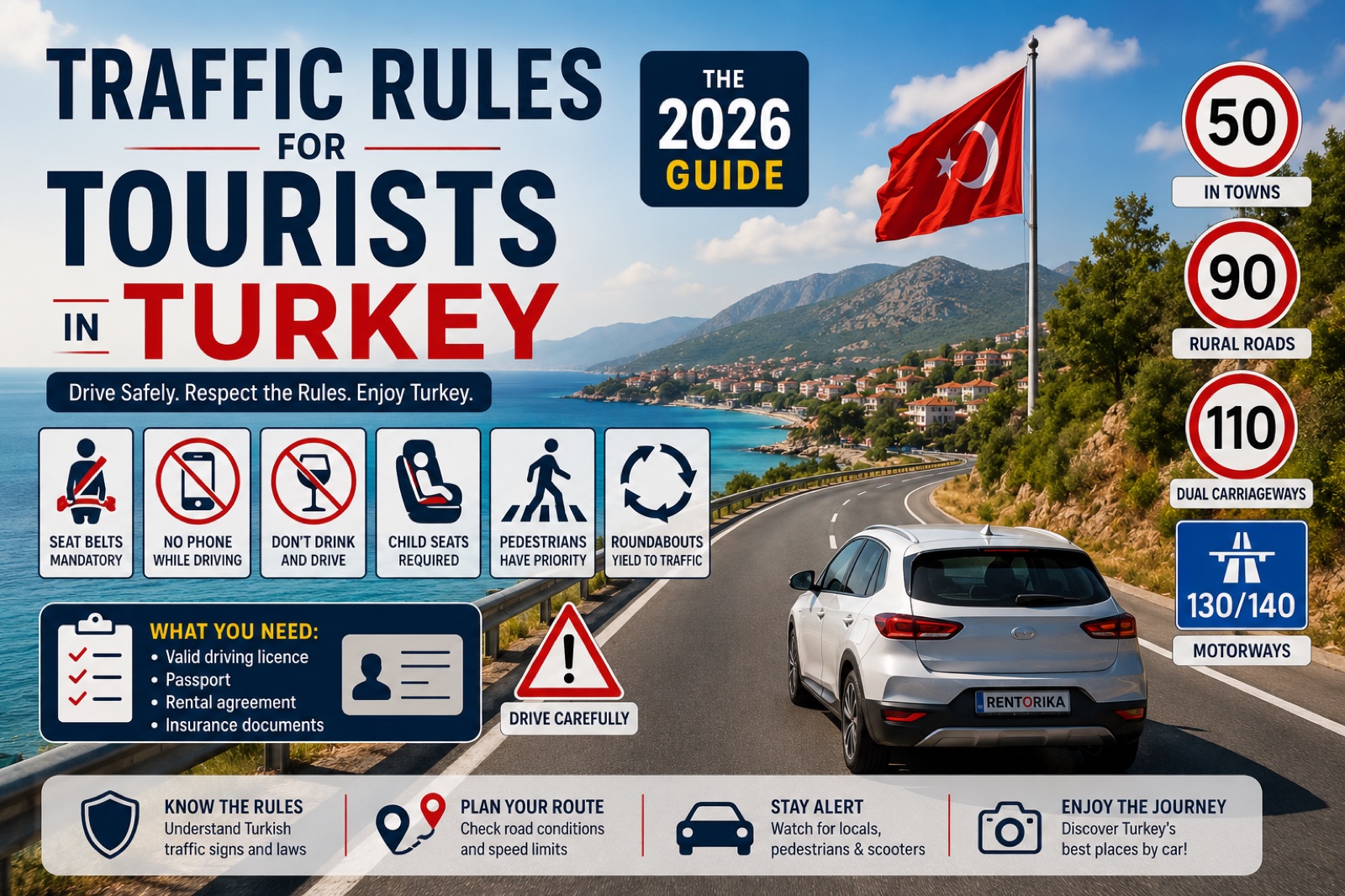
Otoyol (motorway) — the tolled, divided highway network, generally the best-maintained roads in the country, with a 120 km/h default limit, HGS tolling throughout, and the highest concentration of average-speed enforcement zones.
Devlet yolu (state road) — the main non-tolled intercity network, connecting cities and regions the motorway network doesn't directly serve, generally carrying a 90 km/h rural default with lower-quality surfacing and less consistent signage than the otoyol network in places.
Il yolu (provincial road) — smaller regional connectors, often the only practical route to more remote villages, viewpoints, and rural attractions, with variable surface quality and the least consistent enforcement presence of any category, though also the category where road hazards (livestock, unmarked bends, minimal shoulder) matter most.
Urban/municipal streets — governed by the 50 km/h urban default and subject to the densest camera and enforcement coverage in the country, concentrated in city centers and near schools, hospitals, and other sensitive zones where lower informal tolerance for violations is common even where it isn't specifically posted.
Recognizing which category you're on — motorway signage is distinctly numbered and colored, typically with a route number prefixed "O," while state roads use a "D" prefix — helps you anticipate both the applicable limit and the realistic enforcement risk on any given stretch.
Speed Limits: The Full Breakdown
Turkey's road network splits into distinct categories, each carrying its own default speed limit, and posted signage overrides the default whenever it appears — always follow the sign over the general rule if the two ever conflict.
- Urban/residential areas: 50 km/h, and this applies the moment you pass a town or city limit sign, even in villages that look far too small to formally enforce a limit — this is exactly where a disproportionate share of tourist speeding tickets originate.
- Rural roads outside built-up areas: 90 km/h on standard two-lane rural roads.
- Divided highways/expressways (non-motorway): typically 100–110 km/h, depending on specific road classification and signage.
- Motorways (otoyol): 120 km/h as the standard default, though some newer motorway sections post higher limits, and Turkish drivers in personal vehicles are informally known for treating posted highway limits as a soft ceiling rather than a hard one — a habit that, as a tourist in a rental car under a stricter, more visible enforcement regime, is genuinely not worth copying.
The 2026 Speeding Fine Structure, in Detail
This is the single biggest procedural change tourists need to understand. Turkey's old system calculated speeding fines as a percentage of how much a driver exceeded the limit. The 2026 amendment scrapped that entirely in favor of a graduated system based on the exact number of kilometers per hour over the limit, with different, stricter thresholds for violations inside residential/urban areas versus violations on rural roads and motorways outside them.
Inside residential and urban areas, the tolerance margin is deliberately narrow — administrative sanctions begin at just 6 km/h over the posted limit, reflecting the much higher pedestrian density and correspondingly higher risk in these zones. Fines scale upward through several bands as the excess speed increases, reaching a top tier of 30,000 lira for exceeding the limit by 66 km/h or more, which also triggers a 90-day license confiscation, not just a fine.
Outside residential areas — rural roads, highways, and motorways — the tolerance margin is somewhat wider, with administrative sanctions beginning at 11 km/h over the posted limit. The fine structure escalates through similar bands, again reaching 30,000 lira at the highest tier (71 km/h or more over the limit outside residential areas), paired with the same 90-day license confiscation.
License suspension escalates independently of the fine amount at the higher speed bands: roughly 46–55 km/h over the limit in a residential area triggers a 30-day suspension, 56–65 km/h over triggers 60 days, and 66 km/h or more over triggers the full 90-day suspension — a structure mirrored, with adjusted thresholds, on non-residential roads. This means a single serious speeding violation can now cost a tourist meaningfully more than a fine on a card statement: it can end a road trip early if the license itself is confiscated roadside.
What this means practically for a rental driver: the days of treating a speed limit as a loose suggestion with a modest financial penalty attached are over. A moderate violation is a manageable fine; a serious one now carries a real risk of losing your license for the rest of the trip, regardless of how many more days your rental was booked for.
A Worked Example: What a Real Violation Actually Costs
Numbers land better with a concrete scenario than an abstract band description. Consider a tourist driving 68 km/h in a 50 km/h urban zone approaching a coastal resort town — 18 km/h over the posted limit. Under the 2026 residential-area fine structure, this lands in one of the mid-range bands, well below the 30,000-lira top tier but still a meaningfully sized fine by pre-2026 standards, likely in the low thousands of lira. Compare that to a driver going 125 km/h in that same 50 km/h zone — 75 km/h over — which lands squarely in the top tier: the full 30,000-lira fine plus a 90-day license confiscation, effectively ending that person's ability to drive for the remainder of any trip shorter than three months. The gap between "moderately over the limit" and "seriously over the limit" isn't linear anymore — it's a cliff, deliberately, and that's precisely the point of the 2026 restructuring.
Speed Cameras and Enforcement Technology
Turkey's enforcement network has expanded meaningfully alongside the new fine structure, and understanding the different systems in play helps explain why "I didn't see a camera" isn't the defense it might once have felt like.
Fixed radar and red-light cameras are common on intercity highways, at major urban intersections, and increasingly on secondary roads near tourist areas — these are stationary, generally marked with advance signage, though the signage isn't always prominent enough to spot at highway speed if you're not specifically looking for it.
EDS (Elektronik Denetleme Sistemi), Turkey's broader electronic surveillance system, covers red-light violations, bus-lane misuse, illegal turns, and speed enforcement through a combination of fixed installations and mobile units — vans and portable radar setups that park on bridges, highway shoulders, and lay-bys without published locations or advance notice. These are deployed most heavily around Istanbul, Ankara, and the summer coastal holiday routes, precisely where tourist rental traffic concentrates.
Average-speed (point-to-point) enforcement appears on select motorway corridors: your plate is logged at one point and again further down the road, and if your average speed between the two exceeds the limit, you're fined even if your speed at any single instant stayed under the cap. This system is expanding under the 2026 amendments and specifically defeats the old habit of slowing down only when passing a known fixed camera location — there's no "safe" stretch to speed on between two average-speed checkpoints.
Why Average-Speed Enforcement Catches More Tourists Than Fixed Cameras
Fixed cameras are, in a sense, forgiving of a driver's mental map — once you know where one is, you know where the risk sits, and plenty of local and returning visitor drivers genuinely do slow down at exactly that point and speed back up immediately after. Average-speed systems remove that entire strategy, since the measurement isn't a single instant but the full distance between two points, sometimes tens of kilometers apart. A driver who speeds up for open, empty-looking stretches of otherwise well-maintained motorway — a genuinely tempting habit on Turkey's smoother toll roads — can still land in violation even if they never once see anything resembling a fixed camera along the way. The only reliable countermeasure is maintaining the actual posted limit consistently across the whole monitored stretch, not adjusting speed based on visible landmarks or perceived camera locations.
Radar detector hardware is illegal in Turkey, full stop — possession, not just use, can carry its own separate penalty. The only reliable strategy under this enforcement environment is driving the posted limit consistently, not trying to out-technology a system built specifically to catch that behavior.
Illegal Parking as a Related Traffic Violation
Worth flagging here since it sits adjacent to the enforcement technology discussed above: illegal parking — blocking a marked zone, parking in a resident-only area, or stopping in a clearly restricted stretch — is enforced both by traffic police issuing tickets in person and, in major cities, by camera systems that log violations without an officer present. Fines for illegal parking are generally lower than moving violations like speeding, but repeated or severe cases (blocking emergency access, parking in a way that obstructs traffic flow) can escalate to towing, which costs considerably more in time than the fine itself and is a genuinely disruptive way to lose a chunk of a travel day tracking down an impound lot.
Alcohol and Drug Laws: Zero Tolerance Isn't a Slogan Here
Turkey's approach to drink-driving tightened considerably under the 2026 law, and the rules aren't uniform across all drivers — a detail that catches out tourists who assume one blanket limit applies to everyone.
The standard blood alcohol limit for private vehicle drivers is 0.05% BAC — comparable to much of continental Europe, and higher than the UK's or most US states' limits, but still a genuinely low threshold that a single drink can approach depending on body weight and timing.
Commercial drivers face a 0.00% limit, full zero tolerance, no ambiguity.
Here's the detail that catches tourists specifically: drivers within their first five years of holding any license — a category that includes plenty of visiting tourists with genuinely recent licenses, not just young drivers — are also held to the 0.00% zero-tolerance standard, not the standard 0.05% limit. If you passed your driving test within the last five years, treat any alcohol and driving in Turkey as fully incompatible, not "probably fine at one drink," because the legal threshold that applies to you specifically may be zero.
Refusing a breathalyzer or requested drug test carries severe consequences under the 2026 law: an upfront administrative fine around 150,000 lira and license confiscation for five years. This is a dramatic escalation from older, more modest refusal penalties, and it removes "just refuse and deal with it later" as any kind of reasonable strategy.
Enforcement is active, not theoretical — roadside checkpoints are common, particularly on routes leaving resort towns and nightlife districts in the evening, and around public holidays when both authorities and the traffic they're managing are especially alert to drink-driving risk.
The genuinely simplest approach, given the layered limits above: treat alcohol and driving as fully incompatible for the length of your rental, regardless of which specific limit technically applies to you. Guessing wrong about which threshold you fall under isn't a risk worth taking against a 150,000-lira refusal penalty or a license-confiscating BAC reading.
How Turkey's Alcohol Limits Compare to Common Home Countries
Context helps calibrate risk here. A driver arriving from the UK or most of the US, where the standard limit sits around 0.08% BAC, is used to a meaningfully more permissive threshold than Turkey's standard 0.05% — meaning a level of drinking that would be legal to drive on at home could already be a violation in Turkey even under the standard limit, before factoring in the stricter zero-tolerance rules for new drivers. A driver from much of continental Europe, where 0.05% is itself the norm, will find Turkey's standard limit familiar — the real adjustment for this group is specifically the new-driver and commercial-driver zero-tolerance carve-outs, which are stricter than what many European countries apply. Either way, the safest planning assumption for a rental trip is the same regardless of home-country baseline: budget zero alcohol for any day you're driving, and treat it as a genuine trip-planning decision (who's driving today, what does everyone else get to enjoy) rather than something to work out in the moment at dinner.
Seatbelts: Front, Back, and a New Camera Push
Seatbelt enforcement in Turkey has moved well beyond the front seats. Under the 2026 fine structure, a seatbelt violation carries a fine around 3,400 lira, applying to every occupant of the vehicle, not just the driver or front passenger.
Rear-seat enforcement has become a genuine priority, not an afterthought — the driver is held responsible for ensuring every passenger under 18 in the vehicle is properly buckled, with each unbuckled rear passenger treated as a separate violation carrying its own fine. Some cities have begun piloting camera-based detection specifically for rear-seat seatbelt compliance, meaning the days of assuming rear passengers are effectively unmonitored are ending, city by city.
The practical rule for a rental car with kids or multiple adults in the back: everyone buckles in, every time, front and rear, without exception — a habit worth establishing from your first minute in the car rather than a rule you remember only after seeing a checkpoint ahead.
Mobile Phones and Distracted Driving
Using a handheld mobile phone while driving is illegal and actively fined — under the current fine structure, this carries a penalty around 6,800 lira, among the higher common fines a tourist is likely to actually encounter, roughly double the seatbelt violation amount.
This includes using a phone as a navigation device if it's not properly mounted. A phone propped against the dashboard or held in a driver's lap while glancing at directions counts as the same violation as a phone call — a proper mount, either brought from home or bought cheaply on arrival at any electronics shop or fuel station convenience store, removes this risk entirely and costs a fraction of a single fine.
Hands-free calling through a vehicle's built-in system or a Bluetooth headset is permitted, matching the standard exception found across most of Europe — the restriction is specifically on handling the device itself while driving, not on taking calls at all.
The Points System and How It Interacts With Fines
Beyond the direct fine amount attached to any given violation, Turkey operates a penalty-point system layered on top — accumulate enough points within a defined period and license suspension follows independent of whether any single violation alone would have triggered one. Under the 2026 amendments, the standard points threshold before suspension sits at 100 for an established driver, but drops to 60 for anyone within their new-driver probationary period, now extended to two years. For a short-term tourist rental, accumulating enough points to trigger a suspension purely through this mechanism would require multiple documented violations within a single trip — genuinely unusual, but not impossible for a driver who treats several minor rules casually across a multi-week itinerary. The practical takeaway: even violations too minor to feel individually consequential can compound in a system explicitly designed to track cumulative behavior, not just isolated incidents.
Documents, License Validity, and the International Driving Permit
Your home driving license remains valid in Turkey for a defined window tied to your entry, not indefinitely. Non-Turkish citizens — tourists and short-stay visitors — can drive on a foreign license for up to six months from each entry into the country, and this window resets every time you cross a border back into Turkey, which matters if your trip involves leaving and re-entering (for instance, a longer regional itinerary through the Caucasus or the Balkans that loops back through Turkey).
An International Driving Permit is not strictly a legal requirement for every nationality, but it's strongly recommended regardless, particularly if your home license isn't printed in the Latin alphabet — and it's worth knowing that plenty of individual rental companies require one as a condition of the rental itself, independent of what Turkish law technically mandates. Bringing one removes any ambiguity at a roadside stop and at the rental counter alike, and it costs very little to obtain before you travel.
Once the six-month window closes, a foreign license alone is no longer sufficient, and continuing to drive on it becomes a separate offense under the Highway Traffic Code, carrying its own fine and — if caught — an immediate roadside ban from continuing the drive. This scenario is genuinely rare for a standard two-or-three-week tourist rental, but relevant for anyone on a longer stay, a digital-nomad-style extended trip, or a multi-month regional loop.
A Realistic Scenario Walkthrough: Documents at the Rental Counter
It's worth picturing how this actually plays out at pickup, since the documents section of a rental checklist can otherwise feel abstract. You arrive at the counter with your passport, home driving license, and — ideally — an IDP. Staff check that your license has been held long enough (most companies require a minimum of one to two years), verify your passport name matches the booking, and confirm the credit card for the deposit is in the main driver's name. If your license isn't in the Latin alphabet and you don't have an IDP, this is the point where a company may decline the rental outright, regardless of how far in advance you booked — which is exactly why sorting this out before you fly, not at the counter, matters as much as it does. Assuming everything checks out, the six-month driving window described above starts counting from your entry stamp, not from the rental start date, a distinction that matters only if there's a gap between when you entered Turkey and when you actually picked up the car.
If Your License Doesn't Use the Latin Alphabet
This deserves a specific note, since it affects a meaningful share of international visitors and is often glossed over in generic rental checklists. If your home license is issued in a script other than the Latin alphabet — Cyrillic, Arabic, Chinese, or others — Turkish authorities and rental companies alike generally treat an IDP as functionally necessary rather than merely advisable, since it provides the standardized Latin-alphabet translation layer that lets a traffic officer or rental agent verify your license details without needing to read your home country's script directly. Arriving without one in this situation carries a real risk of a rental company declining to hand over the keys at all, regardless of how far in advance the booking was confirmed online — get the IDP sorted at home before you fly, since it typically cannot be arranged once you've already arrived in Turkey.
Headlights, Equipment, and Less Obvious Rules
Headlights are required in tunnels and in reduced visibility conditions, and a large share of rental cars in Turkey run with daytime running lights active by default regardless of the legal minimum — a dashboard indicator related to this is normal, not a warning sign that something's wrong with the car.
Winter tires or snow equipment become relevant only for inland and eastern regions during winter months (roughly November through March) — irrelevant for the large majority of coastal tourist itineraries, but a real consideration for anyone driving toward central or eastern Anatolia outside the summer season.
Child restraint requirements follow an age- and size-based system broadly similar to Western European norms: young children must be secured in an appropriate child seat rather than a standard seatbelt alone, with the exact requirement scaling by age and height bracket. Rental companies typically offer child seats for an additional fee — worth booking in advance rather than requesting one at the counter, since specific sizes aren't always in stock on short notice.
Emergency equipment — a warning triangle and a reflective vest — is a legal requirement to carry in the vehicle, and standard rental cars in Turkey are supplied with both as part of the vehicle's standard kit; it's worth doing a quick visual check for these at pickup rather than assuming, particularly with smaller local operators.
Road Signs Worth Recognizing on Sight
Turkish road signage broadly follows the same international pictogram conventions used across Europe, so most signs are intuitively readable even without language knowledge — a red circle means prohibition, a triangle means warning, a blue circle means a mandatory instruction. A handful of text-based signs are worth specifically recognizing:
- Dur — stop
- Yol ver — yield/give way
- Tek yön — one way
- Girilmez — no entry
- Park yapılmaz — no parking
- Yol çalışması — road works ahead
- Dikkat — caution/attention
- Hız sınırı — speed limit
- Okul geçidi — school crossing, typically paired with a lower local speed limit and higher enforcement sensitivity
- Şehir merkezi — city center
How Fines Actually Get Paid, and What Changed for Rental Drivers Specifically
On-the-spot payment at a roadside stop is a real possibility for certain violations, and Turkish traffic law has traditionally offered a reduced-rate early payment window — historically a meaningful discount, commonly cited around 25%, for fines settled within a set number of days of issue rather than left until later. This discount structure remains part of the system under the 2026 amendments, layered on top of the higher base fine amounts, so prompt payment still meaningfully reduces the total cost of a violation compared to letting it sit.
For a rental car specifically, most fines aren't paid on the spot at all — a camera-issued ticket (speeding, red light, EDS-detected violations) is registered against the vehicle's plate, and since the rental company is the registered operator, the notice goes to them first. The company then identifies which specific rental period the violation falls within, and passes the fine — frequently along with an administrative handling fee on top of the fine itself — to the card left on file, sometimes weeks after you've already returned home.
The 2026 law's joint liability language reinforces this pathway rather than changing it fundamentally: the vehicle's registered operator (the rental company) carries responsibility alongside the driver, which in practice means rental companies have become more diligent about tracking exactly which renter was driving during any specific violation window, precisely so they can pass costs through accurately rather than absorbing them.
A new and genuinely important 2026 rule ties this whole chain together at the border: Turkish customs authorities now check for unpaid traffic fines and outstanding HGS toll charges specifically on foreign-plated vehicles before clearing them to exit the country. For a standard short-term rental, this is handled automatically by the rental company's own account and shouldn't affect your personal departure — but it's a meaningful new consideration for anyone driving a privately owned or long-term foreign-registered vehicle into and out of Turkey, where unresolved fines can now genuinely complicate leaving the country, not just show up as an inconvenient bill later.
What This Means for Your Rental Insurance
It's worth understanding how a traffic violation interacts with your rental's insurance coverage, since the two are handled entirely separately. A speeding or parking fine is an administrative penalty owed to the state, processed through the mechanism described above — it has nothing to do with your collision damage waiver, deposit, or theft protection, and paying a traffic fine doesn't touch your insurance standing at all. Where the two categories can intersect is in the event of an accident: if a violation (speeding, for instance) contributed to a collision, insurers and rental companies alike may treat that differently than an accident with no contributing violation, potentially affecting how cleanly a claim proceeds. This is one more practical reason driving within posted limits matters beyond the fine itself — it keeps a bad-luck accident from becoming a bad-luck accident complicated by a documented rule violation on top of it.
A Note on Rental Company Communication Standards
A well-run rental company, the kind worth booking with in the first place, will proactively flag any of this at pickup — not bury it in fine print you're unlikely to read closely while jet-lagged at an airport counter. If a company's pickup briefing covers documents, fuel policy, and toll mechanics but says nothing about traffic rules or the current fine environment, that's worth noticing as a gap, not necessarily a red flag on its own, but a reasonable prompt to ask directly: "Is there anything specific about current traffic enforcement I should know before I drive off?" A company confident in its own fleet and process will answer this clearly and quickly; hesitation or a vague answer is worth factoring into how much independent research you do yourself before setting off.
New Driver Rules (Relevant If You Recently Passed Your Test)
Turkey extended its probationary period for new drivers under the 2026 amendments, moving from one year to two years, and lowered the penalty-point threshold that triggers license suspension during this window from 100 points down to 60 — meaning new drivers, Turkish or foreign, face suspension after meaningfully fewer violations than an experienced driver would. Combined with the zero-tolerance alcohol threshold that also applies specifically to drivers within their first five years of holding a license, this means a genuinely recently licensed tourist is operating under a materially stricter rule set than someone who's held a license for a decade — worth knowing honestly about your own driving history before assuming standard tourist advice applies evenly to you.
Vehicle Safety Standards You'll Notice as a Passenger, Not a Driver
Turkey has also aligned new-vehicle safety requirements with broader UNECE standards under the 2026 regulatory push — newer vehicles entering the market must include automatic emergency braking, lane departure warning, and tire pressure monitoring systems as standard equipment. This isn't a rule you personally need to comply with as a renter, but it's worth knowing as context: a newer rental car, particularly from a larger international chain replacing fleet vehicles regularly, is increasingly likely to include these systems already, which can feel unfamiliar if you're not used to lane-departure alerts or automatic braking intervention — worth a moment at pickup to understand what warnings the specific car might give you, rather than being caught off guard by an unfamiliar beep or vibration on your first highway stretch.
What to Do If You're Stopped by Police
Being stopped by Turkish traffic police (Trafik Polisi) as a tourist is rarely dramatic in practice, but a few habits make the interaction smoother.
Keep your documents accessible but not loose — passport, driving license, IDP if you have one, and rental agreement paperwork, ideally in a single folder or pouch rather than scattered across the car, so you're not fumbling through a glovebox while an officer waits.
Stay in the vehicle unless instructed otherwise, roll down the window, and greet the officer calmly — the interaction is procedurally similar to a traffic stop in most European countries, and a cooperative, unhurried demeanor goes a long way regardless of language barriers.
If a fine is issued roadside, ask directly whether the early-payment discount applies and how to pay it — officers dealing with tourist traffic regularly are generally used to walking through this, and clarity at the moment of the stop avoids confusion later about whether or how much was actually owed.
If you genuinely believe a stop or fine was issued in error, note the officer's badge information and the specific circumstances, and raise a dispute through the proper administrative channel afterward rather than arguing extensively at the roadside — this is standard advice anywhere, not specific to Turkey, but worth repeating since the instinct to over-explain in an unfamiliar country is strong.
What Happens Specifically If a Violation Is Linked to an Accident
Most of this guide covers standalone violations — a speed camera catch, an unbuckled seatbelt, a handheld phone. It's worth addressing the scenario where a rule violation and an accident overlap, since the consequences compound rather than simply add together. If police attending an accident determine that a documented violation — speeding, alcohol, a red-light run — contributed to the collision, this becomes part of the official accident report (kaza tespit tutanağı) rather than a separate, unrelated ticket, and it can materially affect both the fault determination between parties and how insurance claims proceed afterward. This is exactly why the advice throughout this guide isn't purely about avoiding a fine — a documented violation at the moment of an accident turns a stressful but manageable situation into a genuinely more complicated one, on top of whatever vehicle damage or injury already needs sorting out.
Common Mistakes Tourists Make With Turkish Traffic Rules
Assuming the old percentage-based speeding fine system still applies. Plenty of outdated blog posts and forum threads describe a gentler, proportional fine structure that the 2026 law replaced entirely — treat any pre-2026 source on Turkish speeding fines as no longer accurate.
Not realizing the alcohol limit isn't uniform. Assuming the standard 0.05% BAC limit applies to everyone, when a recently licensed driver may legally be held to a 0.00% standard instead, is a genuinely easy mistake with a genuinely severe consequence if it goes wrong.
Treating average-speed enforcement zones like fixed-camera zones. Slowing down only when passing a specific point, then accelerating again, doesn't work against a system measuring your average speed across an entire stretch — the whole segment matters, not just the checkpoints.
Assuming a violation "doesn't count" because it wasn't paid on the spot. Camera-issued fines against a rental car are tracked to the plate and matched to your specific rental period regardless of whether you were ever stopped in person — flying home doesn't end the process, it just delays when the charge appears on your card.
Underestimating rear-seat seatbelt enforcement. Treating the back seat as effectively unmonitored is an increasingly outdated assumption as camera-based rear-seat detection expands city by city.
Carrying a radar detector, even out of habit from a country where it's legal. Simple possession is its own violation in Turkey, independent of whether it was ever switched on.
Assuming a modest speeding violation and a serious one carry proportionally similar consequences. As the worked example earlier in this guide shows, the 2026 structure isn't linear — the gap between a manageable mid-tier fine and a trip-ending 90-day license confiscation can be a matter of a few tens of km/h, not a gradual scaling most drivers intuitively expect.
Forgetting that the six-month license-validity window resets at each entry, not each rental. A traveler doing a longer loop through multiple countries and back into Turkey should track their most recent entry stamp specifically, not their first arrival date of the trip overall.
Treating a rental car's built-in safety systems (lane departure warnings, automatic braking alerts) as malfunctions rather than normal features, particularly in newer fleet vehicles now required to include this equipment under 2026 vehicle standards — a quick question at pickup about what warnings a specific car might give avoids confusion on the road.
A Second Worked Example: Alcohol at a Coastal Dinner
Picture a common, entirely innocent scenario: a couple renting a car in Bodrum, out for dinner at a restaurant near the marina, sharing a bottle of wine over the course of the evening. If the driver has held their license for more than five years, the standard 0.05% BAC limit applies — a single glass, spaced well before driving and with food, might plausibly stay under that threshold depending on body weight and timing, though "might plausibly" is exactly the kind of uncertainty worth avoiding rather than testing in an unfamiliar country's enforcement environment. If that same driver has held their license for under five years, the calculation changes entirely: the applicable limit is 0.00%, meaning any detectable alcohol at all constitutes a violation, regardless of how little was consumed or how much time has passed. The practical resolution most couples in this exact scenario land on: designate one person as the non-drinking driver for the evening, rotate the role across the trip if both want to enjoy wine with dinner at some point, and treat the specific BAC math as something to avoid needing to calculate in the first place rather than something to calculate precisely in the moment.
Regional Notes: Where Enforcement Feels Different
Istanbul carries the heaviest and most consistent enforcement presence in the country, given both its size and its role as a testing ground for newer measures like rear-seat seatbelt cameras — expect cameras at most major intersections and along principal arteries, plus a genuinely aggressive local driving culture that a visiting driver should observe rather than emulate.
The Turquoise Coast (Antalya to Fethiye) sees heavy seasonal enforcement in summer specifically around alcohol checkpoints near nightlife districts and EDS mobile units on the coastal highway connecting resort towns — the volume of tourist rental traffic here makes it a natural enforcement priority during peak season.
Cappadocia's rural roads carry lighter general enforcement given lower traffic density, but the region's narrow village roads and occasional unpaved viewpoint access tracks call for reduced speed regardless of the posted limit, purely on safety grounds rather than enforcement risk.
Rural inland and mountain routes, particularly through the Taurus range inland from the southern coast, see less consistent fixed-camera coverage but a real risk from road conditions themselves — livestock, unmarked bends, and shared use with slower agricultural traffic matter more here than camera enforcement does.
The Black Sea coast and eastern regions, less common on standard tourist itineraries but increasingly visited, combine lighter overall enforcement density with genuinely more demanding driving conditions — steeper, more winding roads and, in winter months, weather that simply doesn't factor into a Mediterranean coastal trip at all. A driver heading into these regions should weight road-condition caution over enforcement caution, since the practical risks skew differently than on the well-trodden coastal and Cappadocia routes.
Border regions, relevant primarily to travelers combining Turkey with a Caucasus or Balkans itinerary, carry their own layer of scrutiny beyond standard traffic enforcement — vehicle documentation checks are more thorough near border crossings, and this is exactly where the 2026 customs rule on unpaid fines and tolls becomes practically relevant rather than theoretical, specifically for privately owned vehicles crossing in either direction.
Seasonal Enforcement Patterns Worth Planning Around
Summer (June–August) brings the year's heaviest combination of traffic volume and enforcement presence simultaneously — more cars on the road, more EDS mobile units deployed along coastal routes, and more alcohol checkpoints near resort nightlife districts specifically because this is when both tourist traffic and its associated risks peak together.
Public holidays and religious observances (major national holidays, the start and end of Ramadan, Eid periods) see a genuine spike in domestic travel volume, and enforcement typically intensifies alongside it, particularly around alcohol checkpoints and speed enforcement on the routes connecting major cities to coastal and rural destinations — worth checking whether your travel dates overlap with one of these periods, since both traffic density and enforcement visibility shift noticeably.
Winter (November–March) sees the lightest enforcement presence nationwide in relative terms, simply because there's less tourist and domestic travel volume to police — though this shouldn't be read as license to relax standard driving rules, since the baseline fine structure and camera network remain fully active year-round regardless of season.
How Turkey's 2026 Rules Compare to Neighboring and Popular Countries
Context helps calibrate expectations, particularly for travelers combining Turkey with a wider regional trip. Compared to Georgia and Armenia, both popular pairing destinations for a Caucasus-and-Turkey itinerary, Turkey's fine amounts under the 2026 restructuring are now meaningfully higher and its enforcement technology — particularly average-speed cameras and the EDS mobile network — considerably more developed, meaning a driver who found Georgian or Armenian rural roads relatively relaxed in enforcement terms shouldn't assume the same holds once back across the Turkish border. Compared to Greece or other Southern European coastal destinations, Turkey's core speed limits and structure are broadly similar in shape (urban/rural/motorway tiers), but the specific 2026 graduated fine bands and the zero-tolerance alcohol rule for new drivers are stricter than what several Southern European countries currently apply. Compared to the UAE, another popular destination in this platform's regional coverage, Turkey's enforcement technology is comparably sophisticated, though the UAE's fine amounts for serious violations run considerably higher still — worth knowing if your trip spans both, so you're calibrating caution appropriately for each specific country rather than applying one blanket mental model across a multi-country itinerary.
A Pre-Drive Traffic Rules Checklist
- Confirm how many years you've held your license — if under five, treat the alcohol limit as zero, not the standard 0.05%
- Pack an International Driving Permit even if not strictly required for your nationality
- Bring or buy a proper phone mount before your first drive, not after a fine
- Do a quick visual check for a warning triangle and reflective vest in the car at pickup
- Note your entry date into Turkey, since your six-month license-validity window counts from there, not from your rental start date
- Set a personal rule of zero alcohol on any day you're driving, regardless of which specific limit technically applies to you
- If traveling with children, confirm the rental car's child seat matches their age/size bracket before pickup, not after
- Remind every passenger, front and back, that seatbelts are non-negotiable for the whole rental period
Frequently Asked Questions
Do I need an International Driving Permit to drive in Turkey?
Not strictly required by law for every nationality, but strongly recommended, particularly if your home license isn't in the Latin alphabet — and many individual rental companies require one regardless of the legal minimum, so check directly with your specific company.
What's the blood alcohol limit for tourists in Turkey?
0.05% BAC for most private drivers, but 0.00% (full zero tolerance) if you've held your license for less than five years — a detail that catches out recently licensed tourists who assume the standard limit applies to them.
How much has speeding fine risk actually increased in 2026?
Substantially. The old proportional system is gone, replaced by a graduated structure reaching 30,000 lira plus a 90-day license suspension at the highest speed bands — a meaningfully steeper penalty than the older system carried at equivalent speeds.
Will I be stopped and fined on the spot, or does it arrive later?
Both happen — a manned checkpoint can issue an on-the-spot fine, while camera and EDS-detected violations are matched to your rental period and charged to your card afterward, sometimes weeks later.
Is it true that unpaid fines can now stop me leaving Turkey?
This applies specifically to foreign-plated vehicles at customs, primarily relevant to privately owned or long-term vehicles rather than a standard short-term rental, where the rental company's account absorbs and settles charges on your behalf. It's a genuinely new rule as of 2026, worth knowing about regardless of which category you fall into.
Are radar detectors legal in a rental car in Turkey?
No — possession of radar detector hardware is itself illegal, independent of whether it's switched on, so don't bring one even if it's legal in your home country.
Do rear-seat passengers really need to wear seatbelts?
Yes, and enforcement here has genuinely tightened — the driver is responsible for every passenger under 18 being properly buckled in, with camera-based detection expanding in some cities specifically for rear-seat compliance.
Can I use my phone as a GPS while driving?
Only if it's properly mounted, not held or propped in your lap — handling the device while driving, including for navigation, carries the same fine as a phone call.
What happens if I refuse a breathalyzer test?
A severe penalty under the 2026 law: an upfront fine around 150,000 lira and license confiscation for five years — refusal is not a way to avoid a violation, it's a significantly worse outcome than most likely test results would have been.
Do these rules apply the same way to a rental car as to a Turkish-registered private car?
Yes, the traffic rules themselves apply identically — what differs is how fines reach you, since a rental car's fines route through the rental company's account and onto your card rather than arriving at a home address the way they would for a locally registered vehicle.
Is it legal to drive barefoot or in flip-flops in Turkey?
There's no specific nationwide law banning this outright the way some other countries do, but traffic police can still cite a driver for unsafe footwear under general careless-driving provisions if it's judged to have contributed to an incident — closed, secure footwear is the safer default regardless of the exact legal technicality.
Can I get a discount if I pay a fine quickly?
Historically yes, and this remains part of the system under the 2026 amendments — a meaningful early-payment discount, commonly cited around 25%, applies to fines settled within a set window after issue. For a rental car, this early window is often effectively controlled by how quickly the rental company processes and forwards the charge, which is one more reason prompt, clear communication with your rental company about any known violation works in your favor.
What's the penalty for driving without a seatbelt as a passenger, not the driver?
The fine attaches per unbuckled occupant, and the driver bears responsibility for ensuring passengers under 18 are secured — an adult passenger who chooses not to buckle up can also be individually fined in some enforcement scenarios, reinforcing that this is a whole-vehicle rule, not just a driver's-seat rule.
Are there different rules for motorcycles or scooters if I rent one instead of a car?
Yes, broadly — helmet use is mandatory for both rider and any passenger, with its own fine structure for non-compliance, and motorcycles fall into their own vehicle classification for toll and lane-use purposes. This guide focuses on standard car rental rules; a scooter or motorcycle rental in Turkey carries a meaningfully different risk and rule profile worth researching specifically if that's your plan.
Does Turkey recognize a US or UK driving license without an IDP?
Generally yes for the standard six-month tourist driving window, since both countries issue licenses in the Latin alphabet, but individual rental companies frequently still require an IDP as a condition of their own policy, independent of the legal minimum — always confirm directly with your specific rental company rather than assuming national law is the only requirement that matters.
Is jaywalking or hitting a pedestrian who crossed illegally treated differently under Turkish law?
Driver responsibility in a collision involving a pedestrian is assessed based on the full circumstances — speed, visibility, whether the driver could reasonably have avoided the incident — rather than pedestrian fault automatically clearing the driver, which matches the general approach in most countries. Given how genuinely variable pedestrian crossing behavior can be in busy Turkish commercial districts, as covered earlier in this guide, driving at a speed and attentiveness level that accounts for unpredictable crossings is both a legal and practical necessity, not just a defensive-driving nicety.
Do I need to carry proof of insurance in the car at all times?
Yes — the rental agreement itself, which documents the mandatory third-party liability coverage required by Turkish law, should be kept in the vehicle alongside your other documents, and producing it promptly if requested at a checkpoint is standard practice.
Are dashcams legal in Turkey?
Yes, dashcams are legal and increasingly common, unlike radar detectors — there's no restriction on recording your own driving for personal documentation or insurance-dispute purposes, and footage can be genuinely useful in the rare event of an accident dispute or a contested fine.
What's the realistic chance a typical tourist actually encounters any of this enforcement?
Low, for a driver who follows the core rules covered throughout this guide — speed limits, seatbelts, a mounted phone, zero alcohol while driving. The overwhelming majority of tourist rentals in Turkey proceed without any enforcement interaction at all; this guide exists specifically for the minority of situations where rules aren't followed, not because enforcement is lurking around every corner for compliant drivers.
Where can I check the very latest official fine amounts before my trip?
The Turkish General Directorate of Security (Emniyet Genel Müdürlüğü) and the Ministry of Transport publish official updates to traffic regulations and fine schedules, and these are the authoritative source over any third-party summary, including this one — worth a quick check close to your travel dates if you want figures accurate to the day, since annual revaluation and periodic legislative amendments mean numbers do shift over time.
Traffic rules, fine amounts, and enforcement details in this guide reflect Turkey's Highway Traffic Law as amended and in force as of August 2026, based on the most recent available regulatory updates — fine amounts in particular are subject to further inflation-linked revaluation, so always confirm current figures with an official source (the Turkish General Directorate of Security or your rental company) rather than treating any specific number here as permanently fixed.
Find a car
Prices and availability from local companies — instantly, no enquiries
Tip from RentoRika
Book your car in advance — at least 3–5 days before the trip. In high season (June–September) popular models sell out fast.
Related articles
Ready to go?
Pick a car for your dates — in a couple of minutes.