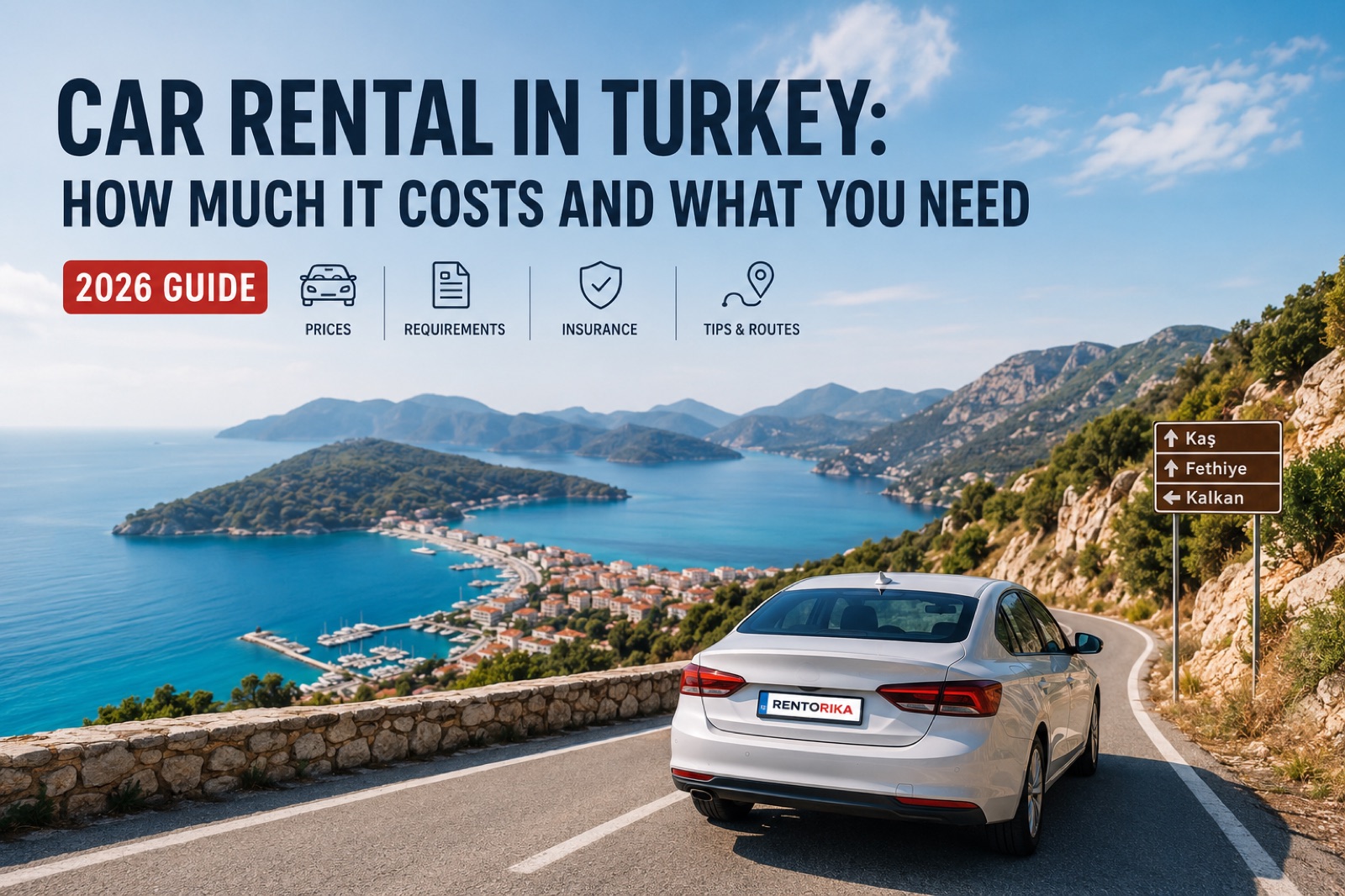
Car Rental in Turkey: How Much It Costs and What You Need (2026 Guide)
Turkey is one of the few countries where a rental car genuinely changes the trip. Public transport along the coast is workable but slow, taxis add up fast over ten days, and the country's best moments — a cove outside Kas that no bus reaches, a village breakfast in the Taurus foothills, a sunset over Cappadocia's valleys — are only available to people who drove there themselves. This guide walks through the real numbers, the paperwork, the rules that actually get enforced, and the traps that catch first-time renters, so you can book with your eyes open instead of guessing.
Find a car
Prices and availability from local companies — instantly, no enquiries
Why Rent a Car in Turkey At All
Turkey is roughly the size of France and Spain combined, and its highlights are spread across a coastline over 8,000 kilometers long, plus an entirely different landscape inland in Cappadocia and central Anatolia. A single all-inclusive resort stay in Antalya or Bodrum doesn't need a car — but almost any itinerary beyond "airport to hotel and back" benefits enormously from one.
Three traveler profiles get the most value out of renting:
If your entire trip is one resort with a wristband, skip this guide and the rental altogether. If it's anything more layered than that, keep reading.
It's also worth being honest about who a rental car doesn't suit. Anyone uncomfortable driving in an unfamiliar country, anyone whose entire itinerary is contained within Istanbul's dense center where traffic and parking work against a car rather than for it, or anyone traveling on a schedule so tight that navigating and parking would eat into time better spent actually seeing things — for these travelers, a mix of taxis, transfers, and organized day tours will usually serve better than a rental. The rest of this guide assumes you've already decided a car fits your trip and want the specifics done right.
- Coastal explorers who want to string together several towns along the Turquoise Coast (Antalya, Kas, Kalkan, Fethiye, Oludeniz) instead of picking one and staying put.
- Cappadocia visitors who want to see the valleys, underground cities, and viewpoints without paying for a different organized tour every single day.
- City-plus-region travelers based in Istanbul, Izmir, or Antalya who want day trips to ancient sites, wineries, or beaches that public transport reaches slowly or not at all.
What This Guide Covers
Everything below is organized in the order most travelers actually need it: pricing first, since that's what brought most readers here, then the paperwork and rules that turn a booking into an actual set of keys in your hand, then the practical, on-the-ground knowledge — fuel, tolls, parking, regional driving conditions — that separates a smooth trip from a stressful one. City-specific sections and route ideas follow for anyone still deciding where exactly to base their trip.
How Much Does It Actually Cost
This is the number everyone wants first, so here it is, with the honest caveat that follows every rental-car price quote in every country on earth: rates move with season, fuel costs, currency swings, and how far in advance you book. Anyone who gives you one fixed number for "car rental in Turkey" without asking your dates is rounding aggressively.
That said, here's what the market actually looks like in practical terms, broken down by what moves the needle.
By Car Class
- Economy (Fiat Egea, Renault Clio, similar): the cheapest and most common class on the road. On the RentoRika platform, Antalya listings start from around €19/day for this class in low season, and Istanbul from around €21/day. Expect these figures to roughly double in July and August.
- Compact / Mid-size sedan: a step up in comfort and trunk space, typically 20–40% above economy pricing. Worth it for two couples traveling together or anyone driving long coastal stretches.
- SUV: increasingly popular for Cappadocia's dirt-adjacent viewpoint roads and for families with luggage. Usually 50–100% above economy pricing depending on brand and size.
- Minivan (7–9 seats): for groups and extended families. Pricing here varies the most by company, since fleet availability for minivans is thinner than for economy cars — book these earlier than you think you need to.
A Sample Cost Breakdown for a Real Trip
Numbers are easier to trust when they're walked through rather than listed in isolation. Take a common scenario: a couple flying into Antalya for a 7-day trip in shoulder season (May), picking up an economy car at the airport, driving the coast toward Kas and back.
At a starting rate around €19–25/day for economy in shoulder season, seven days lands somewhere in the €135–175 range for the base rental. Add mandatory third-party insurance (typically bundled into the quoted rate already, but worth confirming), a modest airport pickup surcharge, and — if the couple chooses the zero-excess insurance upgrade rather than self-insuring — an additional daily fee that can add roughly €5–10/day, or another €35–70 across the week. Fuel for a week of coastal driving in an economy car, covering perhaps 500–700 km round trip with detours, typically runs somewhere in the €50–90 range depending on current fuel prices. Tolls on this specific route are minimal, since the Antalya-to-Kas coastal road isn't a major toll corridor, unlike the Istanbul bridges or the main east-west motorways.
All in, a realistic all-inclusive total for this specific trip — car, optional insurance upgrade, fuel, incidental tolls — lands somewhere in the €250–350 range for the full week, excluding the deposit hold (which is refunded, not spent). Compare that to seven days of taxi transfers between four or five coastal towns, which would likely exceed this total on transportation alone, before any of the flexibility of stopping wherever and whenever is even factored in.
By Season
Turkey's car rental pricing follows tourist demand almost exactly:
- Low season (November–March, excluding New Year): the cheapest window by a wide margin. Coastal towns are quieter, some smaller local rental offices reduce hours, but prices for the cars that are available can drop 30–50% below peak.
- Shoulder season (April–May, October): a genuinely good compromise — warm enough on the coast, still reasonable weather in Cappadocia, and pricing that hasn't hit its summer ceiling yet.
- Peak season (June–September): the most expensive months everywhere on the Aegean and Mediterranean coasts. Istanbul is less seasonal since it's a year-round city break destination, but even there summer carries a premium.
- Local peaks: Cappadocia sees a secondary price bump around its hot air balloon high season (roughly September through November), independent of the coastal calendar.
By Rental Length and Booking Timing
Daily rates drop the longer you rent — a 10-day rental will usually beat the per-day rate of a 3-day rental by a noticeable margin, since rental companies price shorter bookings to cover fixed turnaround costs (cleaning, inspection, paperwork). Booking 3–6 weeks ahead of peak season dates typically beats last-minute pricing; booking the week before a July pickup in Antalya is when you'll see the worst rates and the thinnest selection.
Hidden Cost Drivers Worth Knowing About Upfront
- One-way fees. Picking up in Antalya and dropping off in Istanbul is entirely possible, but it usually carries a repositioning fee that can be substantial — sometimes more than the rental itself for a short trip. Always check this before assuming a one-way route is cheap.
- Young driver surcharge. Most companies apply an extra daily fee for drivers under 25, and some won't rent certain classes (SUVs, larger vehicles) to drivers under 21–23 at all.
- Additional driver fee. Adding a second named driver is usually a flat fee for the whole rental, not a daily charge — but it's rarely free, and driving without being a named, insured driver on the contract is a real risk if something goes wrong.
- Child seat rental. Usually a modest daily or flat fee. Bringing your own from home is often cheaper if you're already checking a bag, but rental units are widely available.
Choosing the Right Car Class for Your Trip
Beyond simple budget, the right class depends on where you're actually driving and who's in the car.
Economy and compact classes suit solo travelers, couples, and anyone whose itinerary stays mostly on well-maintained coastal or highway routes — Antalya to Kas, Izmir to Bodrum, any city-to-city drive on Turkey's main road network. These cars are also, not incidentally, the easiest to park in old town centers with narrow streets and limited spots, which matters more in practice than most first-time renters expect.
Mid-size sedans earn their keep on longer highway stretches where an extra layer of comfort compounds over several hours of driving, and for two couples sharing a car where compact-class trunk space genuinely isn't enough for four sets of luggage.
SUVs make the most sense for Cappadocia's mixed paved-and-unpaved viewpoint access roads, for families needing both space and slightly higher ground clearance, and for anyone planning inland detours off the main highway network where road quality is less predictable.
Minivans are worth booking well in advance if your group needs one — fleet availability for 7-to-9-seat vehicles is consistently thinner than for standard classes across Turkish rental companies, and last-minute searches in peak season frequently come up empty even when smaller classes still show availability.
Automatic vs. manual is its own decision layer, addressed in the FAQ section below, but worth flagging here: if an automatic transmission is a genuine requirement rather than a mild preference, factor that into which class you book, since automatic availability skews toward mid-size and SUV categories more than economy.
What You Actually Need to Rent a Car in Turkey
The paperwork is straightforward, but each of the following four items is a genuine requirement, not a formality that gets waved through if you forget one.
1. A Valid Driving License
Held for a minimum period — most companies require at least one year, though a few request two. If your license isn't in the Latin alphabet, or isn't in English, German, French, or Turkish, you'll need an International Driving Permit (IDP) alongside it. Even when not strictly required by law for your specific nationality, carrying an IDP removes any ambiguity at the rental counter and with traffic police, and it costs very little to obtain before you travel.
2. An International Driving Permit (Recommended for Most Non-European Visitors)
Get this from your home country's motoring authority before you fly — it cannot be issued in Turkey. It's a translation companion to your regular license, not a replacement for it. Bring both.
3. A Passport or National ID
Your booking name, license name, and ID name need to match. This sounds obvious until you're the person whose license shows a maiden name and whose passport shows a married one — sort that out before pickup day, not at the counter.
4. A Credit Card in the Main Driver's Name
This is the requirement that trips people up most often. Rental companies place a security deposit hold on a credit card — not a debit card — and it must be in the name of the driver on the contract, not a travel companion's card. The hold amount varies by car class, typically somewhere between 200 and 800 EUR equivalent, and it's released (not charged) after a clean return, though the release can take anywhere from a few days to a couple of weeks to clear depending on your bank.
Minimum Age
Most companies rent starting at 21, with a young-driver surcharge under 25. Some SUV and premium categories push the minimum age up to 23 or 25 regardless of surcharge. If you're in your early twenties and set on a specific car class, confirm the age policy before you book rather than finding out at the counter.
Insurance: What's Included, What's an Upsell, and What Actually Matters
This is the part of Turkish car rental that generates the most complaints online, almost always because of a mismatch between what a traveler assumed was included and what was actually on the contract. Here's how the layers work.
Mandatory third-party liability (Zorunlu Trafik Sigortası) is required by Turkish law and is baked into every legitimate rental — this covers damage or injury you cause to someone else. It does not cover the rental car itself.
Collision Damage Waiver (CDW) limits your financial responsibility for damage to the rental car, but almost always comes with an excess (deductible) — a set amount you're still on the hook for even with CDW active. This excess is exactly what counter-staff upsell against, offering a "zero excess" or "full coverage" upgrade for an additional daily fee.
Theft protection is a separate line item from collision coverage in many contracts — don't assume CDW covers a stolen vehicle.
The realistic approach: decide before you arrive whether you want to self-insure the excess (accept the risk, save the daily upsell fee, and rely on a travel credit card's rental coverage if you have one) or pay for the zero-excess upgrade upfront. Making that decision calmly at home is far better than making it under mild pressure at a rental counter after an 11-hour flight.
Documentation habit that matters more than any insurance product: photograph or video every visible panel of the car — including wheels, roof, and windshield — before you drive off, with a timestamp visible if possible. This single habit prevents the large majority of deposit disputes that show up in online reviews.
How the Deposit and Payment Actually Work
On RentoRika, bookings work on a 15% prepayment model: you pay a fraction of the total online to confirm the booking, and settle the remainder — plus any deposit hold — directly with the rental company at pickup. This structure exists specifically to reduce your exposure: if plans fall apart, you've only committed a small percentage upfront, and free cancellation windows (typically up to 48 hours before pickup) mean the 15% itself is often recoverable too.
This is worth understanding before you compare RentoRika prices against a headline number from a search engine result — some platforms quote the daily rate without prominently showing mandatory extras (insurance, one young-driver fee, airport surcharge) that only appear at checkout. A genuinely comparable quote includes all mandatory fees, not just the base daily rate.
It's also worth knowing what typically happens behind the scenes between booking and pickup. Once you confirm a booking, the local rental company usually reviews and confirms it within an hour or two, sometimes reaching out directly by message or email to verify pickup time, flight number, or a specific requested car if you selected one by name rather than by class. This confirmation step exists precisely because the platform shows you the exact physical car, not a generic "or similar" class — the company needs to make sure that specific vehicle is actually free at the moment you land.
Search
Pick a city, dates and a specific car with photos
Only 15% prepayment
Online, the rest on pickup
Pickup
You pay the balance and deposit to the company on the spot
How to Choose a Reliable Rental Company
Turkey's car rental market is fragmented across hundreds of local operators alongside a handful of international chains, and the gap in reliability between them is real. A few checks take two extra minutes and meaningfully reduce your odds of a bad experience.
Read recent reviews, not just the average score. A 4.6-star average built on reviews from two years ago tells you less than ten reviews from the last three months. Look specifically for repeated mentions of deposit disputes, hidden fees at pickup, or cars that didn't match photos — a single bad review is normal for any company; a pattern is a signal.
Confirm the car you're booking is the exact car you'll receive. This is the entire point of booking through a marketplace that shows real photos rather than a "class" — if a listing shows a specific make, model, and color, that's what should be waiting for you. If a company tries to substitute a different vehicle at pickup without your agreement, that's a legitimate reason to push back or decline.
Check that the company is a verified, documented operator, not an informal arrangement. Legitimate rental companies in Turkey carry commercial insurance, proper vehicle registration, and business licensing — verification badges on a booking platform exist specifically to filter out operators who skip these basics.
Notice how pickup logistics are described. A company that clearly explains where at the airport to meet them, what their shuttle process looks like, and what documents to bring is signaling operational maturity. Vague instructions ("call us when you land, we'll figure it out") are a mild yellow flag, especially for a first-time visitor unfamiliar with the airport layout.
Fuel: What It Costs and How Rental Companies Handle It
Turkey uses standard unleaded petrol (benzin) and diesel (motorin), both widely available at well-known station brands — Shell, BP, Petrol Ofisi, Opet — across the country, including on most rural routes you're likely to drive. Fuel prices in Turkey have historically run comparable to or above Western European levels due to high fuel taxation, and they move with both global oil prices and the lira's exchange rate, so treat any specific per-liter number as a snapshot, not a constant.
Fuel policy on almost every rental contract is full-to-full: you receive the car with a full tank and are expected to return it full. Return it with less, and you'll pay a refueling fee that includes both the missing fuel and a service charge — consistently more expensive than filling it yourself at a station near the return point. Plan your last fuel stop to be within a few kilometers of drop-off, not out on the highway an hour before.
Diesel vs. petrol: if you're given a choice, diesel typically returns better fuel economy on highway-heavy coastal routes, while petrol economy cars are usually cheaper to rent outright. For short city-based rentals, petrol is simpler; for a long Mediterranean coastal drive, the diesel efficiency can offset the rental price difference.
Currency, Payment, and Avoiding Unnecessary Card Fees
Turkey's currency is the Turkish lira (TRY), and while some tourist-facing rental operations quote prices in euros or US dollars for the convenience of international travelers, the deposit hold and any at-pickup charges are typically processed in lira at the prevailing exchange rate on the day of the transaction. A few practical habits keep this simple.
Let the rental company or card network handle the conversion, not the point-of-sale terminal. When a card machine asks "would you like to pay in your home currency or in lira," choosing lira (the local currency) almost always results in a better exchange rate than accepting the terminal's own conversion — a practice known as dynamic currency conversion that consistently favors the merchant, not you.
Notify your bank of travel dates before you go. A large deposit hold in a foreign country is exactly the kind of transaction that triggers fraud-prevention declines on cards that haven't been flagged for travel — a quick notification through your banking app removes this risk entirely.
Carry a secondary card if possible. Since the deposit hold ties up a meaningful chunk of available credit for the length of your trip, having a second card for day-to-day spending avoids the awkward moment of a declined restaurant payment because your main card is still showing a rental deposit hold from a week earlier.
Electric and Hybrid Rentals in Turkey
Electric vehicle rental availability in Turkey is growing but still limited compared to Western Europe, concentrated mostly in Istanbul and, to a lesser extent, Antalya and Izmir, rather than being broadly available across smaller coastal towns. For travelers specifically interested in an EV or hybrid, a few practical notes matter: charging infrastructure is developing quickly in major cities and along some coastal highway corridors but remains considerably thinner in rural areas and inland regions like Cappadocia, so route planning around charging stops matters more than it would for a standard petrol rental. Hybrid options, which don't carry the same charging-dependency, are more widely available and worth considering as a middle ground — better fuel economy than a standard petrol car without the range-planning overhead of a full EV, particularly useful on longer coastal or highway-heavy itineraries.
What Locals Know That Tourists Often Don't
A handful of practical habits, the kind that don't make it into most rental checklists, come from simply driving these roads regularly.
Friday afternoon traffic leaving major coastal cities is genuinely bad, as weekend getaways compound with regular rush hour — if your schedule allows it, starting a coastal drive on a Thursday or Saturday instead avoids a meaningfully worse experience.
Village speed limits drop sharply and are enforced more consistently than the open-road limits around them — the 50 km/h urban limit applies the moment you pass a town sign, even in villages that look too small to have formal traffic enforcement, and this is exactly where a disproportionate number of speeding tickets to rental cars originate.
Fuel prices vary noticeably between brands and locations, and stations directly off major highway exits or near airports are consistently priced higher than the same brand's stations a few kilometers into town — filling up before joining a highway, not after exiting it, is a small habit that adds up over a week-long trip.
Ramadan and religious holidays shift traffic patterns, particularly around the start and end of Ramadan and during Eid holidays, when domestic travel volume spikes sharply and road traffic in and around major cities and coastal routes increases well beyond typical patterns — worth checking the dates against your travel window if your trip falls during these periods.
Group Travel and Multi-Car Logistics
For larger groups or extended families, the choice between one large vehicle and two smaller ones is worth thinking through rather than defaulting to whichever feels obvious. A single minivan keeps everyone together and simplifies fuel and toll costs into one line item, but it also means the whole group is locked into one schedule and one set of preferences for every stop. Two smaller cars cost more in aggregate but let the group split — one car heading to a hike, another to a beach — and recombine for dinner, which matters more than it sounds like for multi-generational trips where energy levels and interests genuinely diverge. If splitting into two cars, booking both through the same rental company simplifies pickup logistics and often qualifies for a modest multi-vehicle discount worth asking about directly, even when it isn't advertised as a standard offer.
Turkish Traffic Rules Every Rental Driver Should Know
Turkey drives on the right, same as continental Europe and North America, which makes the transition easier for most visitors than, say, arriving in a left-hand-drive country. That said, a handful of specifics catch tourists out consistently.
Speed limits, unless local signage says otherwise, generally run:
Speed cameras are common on intercity highways and are not always obvious in advance — a rental car with an unpaid fine on record can result in a deduction from your deposit weeks after you've flown home, since the rental company is the one who receives the notice and passes the cost (plus an admin fee) to you.
Alcohol limits are strict and enforced with roadside breathalyzer checks, especially around holidays and on routes leaving resort towns in the evening. The safest approach for a rental driver is treating any alcohol and driving as incompatible — enforcement doesn't distinguish between "I only had one" and being genuinely impaired.
Seatbelts are mandatory for all occupants, front and back, and this is actively enforced, particularly in cities.
Headlights are required in tunnels and in poor visibility, and many rental cars in Turkey run with daytime running lights on by default regardless of the legal minimum, which is worth knowing so you don't think a dashboard warning light means something's wrong.
Right of way at roundabouts and unmarked intersections in smaller towns can feel less rigidly enforced than what European drivers are used to — assertive but not aggressive driving, with extra caution at unmarked crossings in villages, will keep you safer than assuming everyone follows textbook priority rules.
Mobile phone use while driving is illegal and fined, including for GPS navigation not properly mounted — a phone holder for your rental dashboard is a cheap and worthwhile thing to bring from home or buy on arrival.
- 50 km/h in built-up urban areas
- 90 km/h on rural open roads outside cities
- 120 km/h on divided highways and motorways
A Short Glossary of Turkish Road Terms Worth Knowing
A handful of words on signage and at rental counters come up constantly and are worth recognizing on sight, even if you don't speak Turkish:
Recognizing these on a sign or a rental contract removes a surprising amount of low-level travel friction.
- Otopark — parking lot or garage
- Mavi alan — blue zone, metered on-street parking
- Benzin — petrol/gasoline
- Motorin — diesel
- Dur — stop (on signage)
- Yol çalışması — road works
- Geçiş ücreti — toll fee
- Kaza — accident
- Trafik sigortası — traffic insurance
- Ehliyet — driving license
Tolls: The HGS System Explained
Turkey's major highways and the Bosphorus and Dardanelles bridges operate on an electronic toll system called HGS (Hızlı Geçiş Sistemi), and there are effectively no cash toll booths left on the routes that matter to a typical rental itinerary — you cannot simply pull up and pay cash the way you might in some other countries.
Almost every legitimate rental car already carries an HGS tag linked to the rental company's account, meaning tolls are charged automatically as you pass, and the rental company bills you afterward — sometimes as a lump sum at drop-off if the system updates fast enough, more often as a post-rental charge to the card on file once the toll authority processes the transaction, which can take one to several weeks. Ask explicitly at pickup how your specific rental company handles HGS billing and whether there's an administrative fee layered onto the toll amount itself — this varies by company, and it's a fair, normal question to ask, not an unusual one.
Toll roads in Turkey are genuinely worth using on longer intercity drives — the alternative free roads are often significantly slower and less well maintained, and the toll amounts on a typical coastal or Cappadocia-bound route are modest relative to the time saved.
Parking in Turkish Cities
Parking splits into three practical categories almost everywhere you'll drive:
Paid parking lots (otopark) are the most straightforward option in dense city centers and near major sites — attended or automated, ticket in, pay on exit, widely available in Istanbul, Antalya's old town area, and most resort towns.
On-street metered parking ("mavi alan," or blue zone, in some cities) typically requires payment via a mobile app, SMS, or a nearby ticket machine, depending on the municipality — the system is not standardized nationally, so what worked in one city may not work identically in the next.
Free street parking exists mostly outside central districts and in smaller towns, but reading local signage carefully matters — restricted zones, resident-only areas, and loading zones are enforced with tickets and occasionally towing, and unlike parking fines that go directly to you, towing your rental car is a genuinely disruptive way to lose half a travel day.
Airport parking, if you're returning the car yourself rather than at a dedicated rental return zone, is usually well signed and separate from general terminal parking — but most rental returns in Turkey happen at a designated rental car zone or via a shuttle-accessible off-airport lot, not the main terminal parking structure, so check your specific instructions rather than assuming.
What to Do in Case of an Accident or Breakdown
Even a well-planned trip occasionally runs into a flat tire, a minor parking-lot scrape, or worse. Knowing the sequence in advance turns a stressful moment into a manageable one.
For any accident involving another vehicle, regardless of how minor it looks, the standard and legally sound approach in Turkey is to avoid moving the vehicles until the situation is documented — Turkish traffic police (call 155) are generally expected to attend and produce an official accident report (kaza tespit tutanağı) for any collision involving two or more vehicles, which is typically required for insurance claims on both sides. Moving cars before this documentation happens, even to "get out of traffic," can complicate the insurance process afterward.
For a single-vehicle incident — a minor scrape against a curb, a cracked mirror, gravel damage on an unpaved Cappadocia viewpoint road — contact your rental company's emergency line immediately, described in your rental agreement, rather than waiting until drop-off to mention it. Companies consistently respond better to prompt disclosure than to damage discovered at return.
For a mechanical breakdown, most rental agreements include 24/7 roadside assistance as a baseline, not a purchased add-on — the phone number is typically printed on the paperwork left in the glovebox or given at pickup. Save this number to your phone the moment you collect the car, before you need it, not after.
General emergency numbers worth saving: 112 is the unified emergency line covering ambulance, fire, and police dispatch nationally; 155 reaches traffic police directly in most provinces.
Navigation, GPS, and Staying Connected on the Road
Turkey's main highways and coastal roads have solid mobile coverage, and standard navigation apps (Google Maps, Waze) work reliably in the areas most tourist itineraries cover — Cappadocia's valley floors and some mountain stretches inland are the main exceptions where signal can drop intermittently.
eSIM or local SIM. A short-term data eSIM activated before you land, or a local prepaid SIM bought at the airport on arrival, is the simplest way to have reliable navigation from the moment you drive off — relying entirely on hotel or café wifi for trip planning while on the road is a recipe for missed turns.
Offline maps as a backup, not a primary tool. Downloading an offline map region before a Cappadocia or rural Taurus mountain drive costs nothing and covers you for the rare dead zone, but offline maps don't include live traffic or road closure data, so they're a safety net rather than your main navigation method.
Phone mounts. Not always included with a rental, and Turkish law treats holding a phone while driving as a punishable offense — a inexpensive dashboard or vent mount, bought locally or brought from home, pays for itself the first time you avoid a distraction fine.
Renting for Families, Solo Travelers, and Business Trips
The right car and rental approach shifts noticeably depending on who's traveling.
Families generally benefit from sizing up — a compact sedan that comfortably seats two adults becomes cramped fast with two adults, two kids, and a week's worth of luggage. An SUV or larger mid-size sedan, plus a rented or brought child seat, is usually worth the incremental daily cost against the alternative of a genuinely uncomfortable week. Booking child seats in advance rather than requesting them at the counter avoids the (fairly common) scenario where the specific size you need isn't in stock that day.
Solo travelers have the most flexibility and the strongest case for the smallest, cheapest economy class available — parking is easier, fuel costs are lower, and narrow village streets in places like Cappadocia's older towns are noticeably less stressful in a compact car than a full-size SUV.
Business travelers on shorter, tighter-scheduled trips tend to value airport pickup and drop-off convenience over the modest savings of a city-center office, and often benefit most from a mid-size sedan that balances comfort for client meetings against easy city parking — a rental history with the same company across repeat Istanbul or Antalya trips can also occasionally unlock informal loyalty perks like a faster counter process, worth asking about directly.
Driving Conditions by Region
Turkey's geography varies enough that "driving in Turkey" means genuinely different things depending on where your itinerary takes you.
The Mediterranean and Aegean coasts (Antalya to Bodrum) offer the best-maintained roads in the country, with a well-developed toll highway network connecting major towns and generally excellent signage in both Turkish and English near tourist areas. This is the easiest region in the country for a first-time visitor to drive confidently.
The Taurus Mountains, inland from the southern coast, involve genuine mountain driving — switchbacks, narrower lanes, and occasional livestock on rural stretches. Well within reach of a normally confident driver in daylight, but worth avoiding after dark on unfamiliar routes if you can help it.
Cappadocia combines good main roads with some unpaved or narrow access tracks near specific viewpoints and valley trailheads — a compact SUV handles this mix more comfortably than a low-clearance economy sedan, though the vast majority of Cappadocia's sights are reachable on paved roads.
The Black Sea coast, less common on first-time tourist itineraries but increasingly popular, sees considerably more rainfall and fog than the rest of the country, along with steeper, more winding coastal roads — worth factoring into your timing and driving pace if this region is on your route.
Eastern and central Anatolia, well beyond most short-trip itineraries but relevant for longer overland journeys, can see genuine winter driving conditions — snow, ice, and mountain pass closures from roughly November through March — requiring winter tires and a different level of caution than a coastal spring or summer trip.
Picking Up at the Airport vs. In the City
Airport pickup costs slightly more in almost every case — usually a modest surcharge baked into the rate — but it removes an entire logistics step: you land, you collect the car, you drive to your accommodation directly instead of taking a taxi or transfer to a city office first. For most travelers, especially anyone landing after a long flight, this convenience is worth the small premium.
City-center pickup can be meaningfully cheaper, and makes sense if you're not renting from day one — for instance, spending your first two or three days in Istanbul or Antalya without a car, then picking one up from a downtown office once you're ready to head out on the road portion of the trip. The tradeoff is an extra taxi or transit leg to reach the rental office, which eats into the savings if you're only renting for a short period.
The busiest and most reliable pickup points for tourist itineraries are Antalya Airport (AYT), Istanbul Airport (IST), Istanbul Sabiha Gökçen (SAW), Dalaman Airport (DLM) for the southwestern coast, Bodrum-Milas Airport (BJV), and Izmir Adnan Menderes Airport (ADB).
Best Regions and Cities in Turkey for a Rental Car
Turkey rewards a rental car differently depending on where you base yourself. Below are the regions and cities travellers pick most often, with what each one actually opens up.
Antalya and the Turquoise Coast
Antalya is the single most common car rental pickup point in Turkey for a reason: it's the gateway to a stretch of Mediterranean coastline where every town along it — Kas, Kalkan, Kemer, Side, Alanya — rewards a car far more than a bus schedule. A rental based in Antalya lets you treat the whole coast as one flexible itinerary instead of committing to one resort town for the entire stay.
Istanbul
Istanbul is the exception to "always rent a car" advice — the city's traffic, parking scarcity, and excellent public transport (metro, tram, ferries) mean a car is often a liability inside the city itself. Where a rental genuinely earns its keep is for day trips outside the city: the Black Sea coast, Sile, the Belgrad Forest area, or heading further afield toward Edirne. The practical pattern many travelers use successfully: no car for the days spent inside Istanbul, then pick one up right before heading out of the city.
Bodrum and the Bodrum Peninsula
The peninsula is built for exactly this kind of trip — a dozen distinct villages (Bodrum town, Gumbet, Bitez, Turgutreis, Yalikavak, Gundogan) each with a different character, close enough together that a car turns a week here into a genuine exploration rather than a single-beach stay.
Cappadocia (Goreme, Nevsehir, Urgup)
Cappadocia is unlike anywhere else in this guide — the driving itself is part of the experience, through valleys, past cave dwellings, and between viewpoints that are genuinely difficult to reach any other way outside of a paid group tour. Roads here are generally in good condition, but some viewpoint access roads are unpaved or narrow, and a compact or small SUV handles them more comfortably than a low-clearance sedan. Balloon season (roughly September to November, plus spring months) brings a secondary demand spike independent of the national summer peak, so book earlier than you might elsewhere in the country.
Izmir and the Cesme Peninsula
Izmir is a genuine city-break destination in its own right and doubles as the gateway to Cesme's beaches and the wine regions of the surrounding countryside, plus easy access to Ephesus and Sirince for travelers who want ancient sites without the Antalya-region crowds.
Fethiye and Oludeniz
Fethiye anchors the southwestern end of the Turquoise Coast and sits right beside Oludeniz's famously photographed blue lagoon, with the Lycian Way's coastal trailheads, paragliding launch points on Babadag mountain, and a scattering of ghost villages like Kayakoy all within a short drive rather than requiring separate transfers for each.
Marmaris
Marmaris works both as a standalone base for its own beaches and marina scene and as a practical link point between the Aegean and Mediterranean coastal routes, with the Datca Peninsula's quieter coves an easy detour for anyone with their own car and no fixed itinerary.
Alanya
East of Antalya, Alanya combines a dense resort strip with a genuinely interesting old town and castle, and a rental car here opens up the smaller coastal villages further east toward Gazipasa that package holidays rarely include.
Pamukkale and Denizli
Pamukkale's white travertine terraces and the ruins of ancient Hierapolis draw a huge number of day-trippers from the coast, but staying overnight nearby with your own car — rather than joining a long round-trip bus tour — means seeing the terraces at sunrise or sunset, well before or after the crowds arrive.
Trabzon and the Black Sea Coast
A genuinely different Turkey from the Mediterranean image most visitors arrive with — green, mountainous, and considerably less touristed. Trabzon serves as the practical base for reaching the Sumela Monastery and the high plateaus (yaylalar) of the eastern Black Sea region, a region best explored with a car given how spread out its highlights are.
Ankara
Turkey's capital rarely tops a first-time visitor's list, but it functions as a practical hub for exploring central Anatolia — the underground cities and rock formations of Cappadocia are a comfortable few hours' drive away, and Ankara itself has more depth (the Anitkabir mausoleum, the Museum of Anatolian Civilizations) than its reputation as "just the government city" suggests.
A Road Trip Idea: What a Turkey Coastal Drive Actually Looks Like
For travelers wondering what a self-driven itinerary here actually feels like in practice, a common and genuinely rewarding structure runs Antalya to Fethiye along the coast, taking in Kas and Kalkan as overnight stops, with detours inland to ancient sites like Myra and the sunken ruins near Kekova reachable only by boat trips departing from small coastal towns you'd otherwise never visit. The full coastal stretch can be driven in under a week at a relaxed pace, or extended significantly if you add inland detours toward Pamukkale's travertine terraces.
A Second Idea: The Cappadocia Loop
For travelers whose entire trip is centered on Cappadocia rather than the coast, a rental car unlocks a genuinely different pace than the standard tour-bus circuit — sunrise at a quiet viewpoint before the balloon crowds arrive, a slow lunch in Urgup rather than a scheduled tour-group stop, and the flexibility to linger an extra hour in Ihlara Valley if the light is good. A comfortable three-to-four-day loop covers Goreme's open-air museum, the underground cities at Derinkuyu or Kaymakli, the Ihlara Valley hike, and the Uchisar and Rose Valley viewpoints, all within a manageable daily driving radius.
A Third Idea: Izmir to Bodrum Along the Aegean
A shorter, less-driven alternative to the Antalya-centric coastal route, this stretch takes in Cesme's beaches and wind-sport scene, the ancient ruins at Ephesus, the pilgrimage site and hilltop village of Sirince, and finishes on the Bodrum Peninsula's string of small resort towns — a genuinely good option for travelers who want history, wine country, and coastline without the higher prices and crowds of the Antalya region in peak summer.
Common Mistakes First-Time Renters Make in Turkey
Assuming the quoted price is the final price. The base daily rate rarely includes mandatory third-party insurance framing, potential young-driver surcharges, or airport fees — always check the total at checkout, not the headline number.
Skipping the pre-rental inspection walk-around. Existing scratches and dents that aren't documented at pickup have a way of becoming your responsibility at drop-off. Five minutes with a phone camera protects you completely.
Not asking about HGS toll billing upfront. A surprise charge weeks after your trip is jarring specifically because it's unexpected — asking the question at the counter removes the surprise entirely.
Returning the car with less than a full tank and assuming the difference is minor. The refueling surcharge is consistently priced to make this the most expensive fuel you'll buy on the entire trip.
Driving toward a border without checking cross-border permission. Standard Turkish rental agreements do not automatically permit taking the car into neighboring countries — this needs explicit, usually written, permission from the rental company, arranged before you leave, not discovered at a border crossing.
Booking the cheapest possible listing without reading recent reviews. In a market with hundreds of local operators, the gap in service quality between rental companies at the same price point can be significant — a few minutes reading recent reviews on a specific company is worth far more than shaving a few euros off the daily rate.
Car Rental vs. Taxi, Bus, and Organized Tours in Turkey
Against taxis: a single intercity taxi transfer in Turkey — say, Antalya to Kas — can cost close to what two or three days of a rental car costs, while leaving you dependent on arranging every subsequent trip separately. Taxis make sense for a single point-to-point transfer; they stop making financial sense the moment you need more than one or two trips.
Against intercity buses: Turkey's bus network is genuinely excellent and comfortable for point-to-point city travel — Istanbul to Izmir, for instance, is a perfectly reasonable bus route. Where buses fall short is flexibility: they connect major towns, not the small villages, hidden beaches, and viewpoint roads that a rental car reaches directly.
Against organized day tours: for Cappadocia specifically, day tours are a legitimate alternative to renting, especially for travelers uncomfortable driving unfamiliar mountain and valley roads. The tradeoff is a fixed schedule and a shared itinerary versus the flexibility of stopping wherever you want, for as long as you want.
The general rule that holds up across all three comparisons: the more towns, sites, or detours your itinerary includes beyond a single base, the more a rental car's cost advantage compounds — and the more a taxi-per-trip or tour-per-day approach compounds against you.
Best Time to Rent a Car in Turkey
If price is your main driver, target April, May, or October — warm enough for most of the country, well below peak pricing, and with thinner crowds at major sites like Ephesus, Pamukkale, and Cappadocia's viewpoints. If Cappadocia's hot air balloons are a priority, expect to pay shoulder-season-adjacent prices even outside the coastal high season, since that demand runs on its own calendar. If your dates are fixed to summer regardless, book your car several weeks ahead rather than on arrival — July and August pickup availability in Antalya and Bodrum tightens noticeably by early June.
Month-by-Month Notes for Drivers Specifically
November–February: the cheapest rental rates of the year on the coast, but also the quietest — some smaller local offices reduce hours or close entirely in the smallest resort towns, so booking through a company with confirmed year-round operation matters more here than in peak season. Inland and eastern regions can see snow and require winter tires.
March: transitional, with coastal pricing still low but weather warming noticeably by the end of the month — a reasonable window for travelers prioritizing budget over guaranteed beach weather.
April–May: widely considered the sweet spot — reliably warm on the coast, wildflowers and green landscapes inland, well below peak pricing, and major sites like Ephesus and Pamukkale noticeably less crowded than in summer.
June: the start of the price climb toward peak, with weather already summer-like on the coast — a reasonable compromise for travelers who want summer conditions without full July/August pricing and crowds.
July–August: peak season in every sense — highest prices, thinnest last-minute availability, hottest weather, and the busiest roads, particularly on Friday afternoons and around domestic holiday weekends.
September: a genuinely underrated month — sea temperatures remain warm from the summer, crowds thin out as school terms resume in most source markets, and Cappadocia's balloon season demand begins ramping up toward its autumn peak.
October: similar logic to April/May in reverse — comfortable temperatures, lower pricing than summer, and one of the best windows for combining coastal time with inland sightseeing before winter weather arrives inland.
Road Trip Preparation Checklist
A short list worth running through the night before pickup, regardless of how experienced a driver you are:
- International Driving Permit and home license, both physically with you, not just photographed
- Passport, matching the name on your booking
- Credit card in the main driver's name, with your bank notified of travel dates
- Confirmation email or booking reference, including pickup time and any specific vehicle requested
- Phone mount for navigation, plus a portable charger for longer driving days
- A downloaded offline map region for Cappadocia or any planned mountain routes, as backup to live navigation
- A saved copy of the rental company's emergency and roadside assistance number, stored in your phone before you need it, not searched for during a breakdown
- A rough idea of your first day's fuel stop location, timed to arrive with a full tank at drop-off if this is your final day
Frequently Asked Questions
Do I need an International Driving Permit to rent a car in Turkey?
It depends on your license's language and issuing country, but carrying one removes any ambiguity, costs little, and is strongly recommended for the majority of non-European visitors even when not strictly mandatory for your specific nationality.
Can I pay the deposit with a debit card?
Almost never. Rental companies in Turkey overwhelmingly require a credit card for the security deposit hold, in the name of the driver on the contract.
Is it safe to drive in Turkey as a foreign tourist?
Yes, for the large majority of visitors — main roads and highways are well maintained, and the driving culture, while more assertive than some Northern European countries, isn't outside what a reasonably confident driver adapts to within the first hour. Extra caution is warranted at night on rural roads and around unmarked village intersections.
What's the minimum age to rent a car in Turkey?
Typically 21, with a young-driver surcharge under 25, though this varies by rental company and car class — some SUV and premium categories set the minimum age higher.
Do I need cash for tolls?
No — Turkey's major toll roads and bridges run on the electronic HGS system with no cash booths on the routes that matter to most itineraries. Tolls are billed automatically through the rental company, usually after your trip.
Can I take a rental car from Turkey into Georgia or another neighboring country?
Only with explicit written permission from the rental company, arranged in advance — standard rental agreements don't cover cross-border travel automatically.
Is it cheaper to pick up in the city or at the airport?
City-center pickup is often somewhat cheaper, but airport pickup removes an extra transfer step — for most travelers landing directly into their road trip, the convenience is worth the modest premium.
What happens if I get a speeding ticket in a rental car?
The rental company receives the notice, since the car is registered to them, and passes the fine plus an administrative fee to the card on file — this can arrive weeks after you've returned home, so driving within posted limits is worth it beyond just safety.
Is fuel expensive in Turkey compared to Europe?
Historically comparable to or above Western European prices due to fuel taxation, though exact figures shift with global oil prices and currency movements — check current pricing rather than relying on older figures.
Should I buy the full insurance upgrade at the counter?
It depends on your risk tolerance and whether you already have rental coverage through a travel credit card. Deciding calmly before you travel, rather than under counter pressure after a long flight, generally leads to a better outcome either way.
Can I drive a rental car at night in Turkey?
Yes, there's no legal restriction on this, though rural mountain routes — particularly in the Taurus range inland from the southern coast — are more comfortably driven in daylight until you're familiar with the road, given narrower lanes and occasional livestock on less-trafficked stretches.
Do automatic transmission cars cost more to rent than manual?
Generally yes, since manual transmission remains the more common and cheaper default across the Turkish rental fleet, while automatic availability is more limited, particularly in economy and compact classes — if an automatic is a requirement rather than a preference, book earlier and expect a modest price premium.
What happens if I return the car late?
Most rental agreements include a grace period, often around 30 to 60 minutes, before a late return triggers an additional charge — sometimes calculated as an extra full day rather than a prorated amount, depending on the company's policy. If you know in advance that your return will run late, calling ahead is far better than surprising the rental office.
Is it normal for a rental company to ask for a copy of my passport in advance?
Yes, this is standard practice for verification purposes ahead of pickup and isn't a red flag on its own — it becomes worth double-checking only if a company asks for payment details outside the platform's official checkout flow, which is a legitimate reason to be cautious regardless of destination.
Can I extend my rental once I'm already in Turkey?
Usually yes, subject to the specific car's availability for the extended dates — contacting the rental company directly a day or two before your original return date, rather than the morning of, gives them the best chance of accommodating the extension with the same vehicle.
Do I need snow tires or chains if I'm renting in winter?
Only relevant for inland and eastern regions, and for mountain routes generally — coastal itineraries around Antalya, Bodrum, or Izmir rarely see conditions requiring winter equipment. If your route includes central or eastern Anatolia between November and March, confirm with the rental company whether winter tires are already fitted, since this varies by region and company.
Is it worth renting a car for just a two- or three-day city stay?
Usually not for Istanbul specifically, given traffic and parking constraints, but often yes for a shorter coastal base like Antalya or Bodrum, where even a short stay benefits from reaching a beach, ruin, or village that public transport handles poorly. The general test: if your short stay includes more than one destination outside easy walking distance, a car likely pays for itself in time saved alone.
Prices, fees, and specific regulations mentioned in this guide reflect typical market patterns and are provided as planning estimates rather than guaranteed current figures — always confirm exact pricing, insurance terms, and deposit amounts directly on the listing before booking, since these move with season, fuel costs, and individual rental company policy.
Find a car
Prices and availability from local companies — instantly, no enquiries
Tip from RentoRika
Book your car in advance — at least 3–5 days before the trip. In high season (June–September) popular models sell out fast.
Related articles
Ready to go?
Pick a car for your dates — in a couple of minutes.