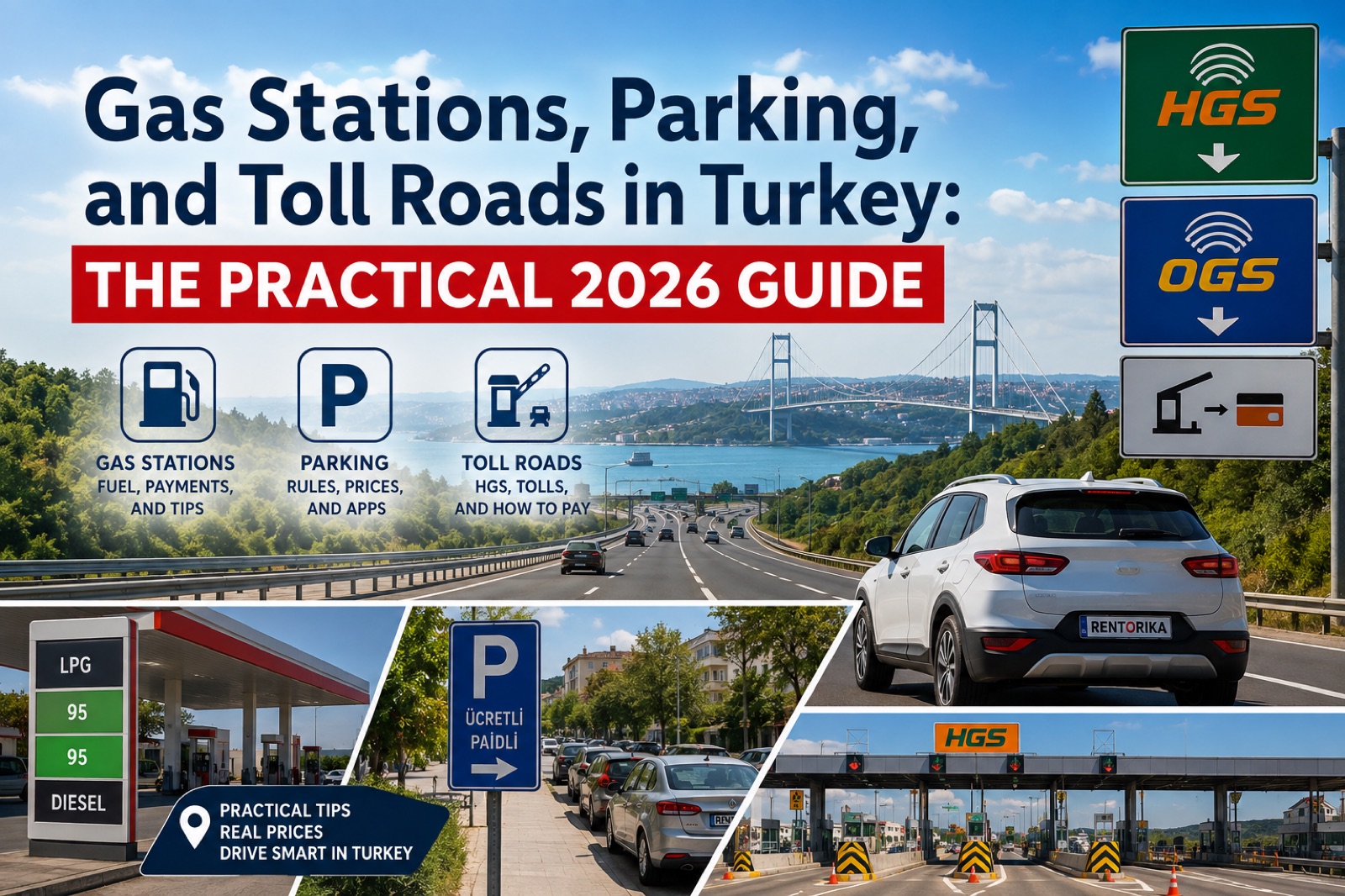
Gas Stations, Parking, and Toll Roads in Turkey: The Practical 2026 Guide
Renting a car in Turkey is the easy part. What actually determines whether your trip feels smooth or mildly stressful is the stuff nobody puts on the booking page: which fuel to put in the tank, how the country's toll system works now that cash lanes are gone entirely, and where you're allowed to leave the car in a city center without a ticket waiting on the windshield when you get back. This guide covers all three, updated for how things actually work as of August 2026 — not a generic checklist copied from a decade-old travel forum thread.
Why This Deserves Its Own Guide, Separate From the Rental Itself
Booking the car is a five-minute decision. Living with the daily mechanics of fueling it, parking it, and passing through Turkey's fully electronic toll system without a single cash option anywhere on the network is what actually shapes whether the week feels effortless or vaguely stressful. Nearly every complaint about "hidden costs" in Turkish car rental traces back to one of these three categories — a refueling surcharge nobody expected, a parking ticket in an ambiguous zone, or a toll admin fee that shows up on a card statement two weeks after the trip ended. None of these are scams or unusual practices; they're simply mechanics that aren't explained clearly enough at the point of booking. This guide exists to close that gap.
Find a car
Prices and availability from local companies — instantly, no enquiries
Fuel in Turkey: What It Costs Right Now and How to Not Overpay
Turkey runs on standard unleaded gasoline (benzin) and diesel (motorin), sold at a small number of dominant national brands — Petrol Ofisi, Shell, BP, Opet, and Lukoil — plus a scattering of smaller regional chains, especially along secondary coastal roads. Coverage is genuinely good: even routes that feel remote, like the inland stretches toward Cappadocia or the mountain roads behind the Turquoise Coast, have stations at intervals that make range anxiety a non-issue for a standard rental car.
Current pricing, as of mid-2026: gasoline sits somewhere in the 62–66 Turkish lira per liter range depending on city and station, with diesel running slightly higher, typically 64–66 lira per liter. In dollar terms that works out to roughly $1.35–1.45 per liter for gasoline and a touch more for diesel — noticeably above the global average, which is exactly what you'd expect from a country that taxes fuel heavily as a matter of policy. Istanbul, Izmir, and Ankara show only modest price variation between them, generally within two or three lira per liter of each other, so there's no real "cheap city" to plan around — pricing is closer to a national band than a city-by-city lottery.
Two things worth internalizing about these numbers: first, they move. Turkish fuel pricing responds to global crude prices and lira exchange rate swings faster than most European markets, since neither is particularly stable at the moment — a number that's accurate this week can be five or ten percent off within a month. Second, treat any specific figure, including the ones above, as a planning estimate rather than a number to budget against to the last lira.
Where Fuel Is Actually Cheaper (and Where It Isn't)
Stations directly at highway exits, near airports, and inside obviously touristy stretches of coastal resort towns consistently price a few lira above the same brand's stations a short drive further into an ordinary neighborhood. This isn't specific to Turkey — it's the same convenience premium you'd find anywhere — but it's worth acting on: fill up before you exit onto a highway or before you reach the airport rental return, not after, and you'll consistently pay less for the exact same fuel.
Brand loyalty apps are genuinely useful here. Petrol Ofisi, Lukoil, and Shell all run mobile apps offering small per-liter discounts or point-based rewards for members — worth downloading even for a short trip, since signup takes a couple of minutes and the discount, while modest per fill-up, adds up over a week of coastal driving.
Fuel Policy on Your Rental Contract
Nearly every rental company in Turkey uses a full-to-full policy: you receive a full tank, you return a full tank. Return the car with less, and you'll be charged for the missing fuel plus a refueling service fee that's calculated to make this option consistently more expensive than a normal station fill-up — occasionally two to three times the going rate per liter once the service charge is included. The fix is simple and costs nothing: plan your last fuel stop within a few minutes of your return point, not out on the highway an hour before.
Diesel or petrol, if you're offered a choice: diesel typically returns meaningfully better fuel economy on long highway stretches — relevant if your itinerary is heavy on intercity coastal driving — while petrol economy-class cars tend to have a lower rental price outright. For a short city-based rental, this barely matters; for a week-long coastal road trip covering several hundred kilometers, the diesel efficiency can genuinely offset a chunk of the rental cost difference.
Parking in Turkey: A City-by-City Reality Check
Parking in Turkey isn't governed by one national system — it's a patchwork that changes from city to city, sometimes from district to district within the same city, which is exactly why generic advice ("just use the blue zone") tends to fall apart the moment you actually need it.
Istanbul
Istanbul's official municipal parking system is called ISPARK, covering roughly 400 managed lots and garages across the city, and it's the backbone of organized city-center parking here. The official ISPARK mobile app lets you locate the nearest available lot, see real-time space counts, and pay directly through the app rather than fumbling with cash at a booth. It works, but it's not the smoothest piece of software you'll use on your trip — plenty of regular users describe it as functional rather than polished, and a couple of independently built alternatives, like Parkera, offer a cleaner interface pulling from the same underlying availability data across 100-plus Istanbul car parks, worth having as a backup if the official app frustrates you.
On-street metered parking (commonly referred to as the blue zone) exists in commercial districts but is genuinely inconsistent in coverage and payment method between neighborhoods — some stretches use a phone-based payment code posted on nearby signage, others use a physical ticket machine. Read the specific signage at your parking spot rather than assuming yesterday's method applies today's street.
The honest Istanbul advice, unchanged by any app improvement: if your itinerary is contained within the city center, a car is more often a liability than a convenience, given traffic density and the genuine scarcity of easy parking near major sites like Sultanahmet or Taksim. Save the rental for the day you're heading out of the city.
Antalya, Bodrum, and Coastal Resort Towns
Coastal resort towns run considerably more relaxed parking regimes than Istanbul. Purpose-built otopark lots near old town centers, marinas, and major beaches are common, generally affordable, and straightforward — pay on entry or exit, no app required in most locations. Free street parking is genuinely available outside the densest tourist cores, particularly in residential side streets a short walk from the main attractions, though it thins out considerably during peak July–August season when both locals and tourists compete for the same limited spots.
A practical habit for resort towns: hotels increasingly offer free or discounted parking for guests, sometimes not prominently advertised — it's worth asking directly when booking accommodation rather than assuming you'll need to find street parking every single night of a multi-day stay.
Cappadocia (Goreme, Nevsehir, Urgup)
Parking here is the least formal of any region in this guide — small towns, low traffic density outside peak balloon-viewing hours, and mostly free, unregulated parking near hotels, cave-hotel guesthouses, and trailheads. The one genuine consideration is early-morning balloon season traffic (roughly September through November, plus spring): popular sunrise viewpoints fill their informal parking areas quickly, and arriving even twenty minutes later than planned can mean parking considerably further from the viewpoint than you budgeted for on foot.
Airport Parking
Istanbul Airport (IST), run by the iGA operator, is the largest and most structured airport parking setup in the country: five covered multi-story car parks color-coded Blue, Yellow, Red, Turquoise, and Purple, split between the international side (Blue, Yellow, Red) and domestic side (Turquoise, Purple), plus a cheaper open-air lot. As of the 2026 tariff, covered parking runs roughly 250 lira for the first hour and around 740 lira for a full 24 hours, with the open-air lot pricing meaningfully lower — around 190 lira and 520 lira respectively — and including a free first fifteen minutes. Paying through the official iGA mobile app knocks a further 10% off the listed rate, and the airport offers valet parking and EV charging as well. None of this is where most rental drivers actually park, though — nearly all rental returns happen at a dedicated rental-car zone or an off-airport shuttle lot specific to your rental company, not general terminal parking, so follow your specific return instructions rather than assuming the terminal garages apply to you.
Antalya, Izmir, Bodrum, and Ankara airports each run their own parking operations, generally simpler and cheaper than Istanbul's given lower overall traffic volume, with dedicated apps (several run under the TAV group, which manages multiple Turkish airports) providing live rates and space availability if you need general terminal parking rather than a rental return zone.
Istanbul Sabiha Gökçen (SAW), the city's secondary airport on the Asian side, runs a smaller and generally more straightforward parking operation than IST — fewer car parks, lower relative pricing, and less of the sprawling terminal-navigation complexity that comes with IST's scale. Since SAW handles a large share of low-cost carrier traffic, it's worth checking which airport your specific flight actually uses before assuming IST's parking and pickup logistics apply — the two airports sit on opposite sides of the city and the difference matters for planning your first hour in Turkey.
What Locals Do Differently
A handful of habits, gathered from simply driving these roads and using this parking system regularly, don't always make it into a standard rental checklist.
Locals top up HGS balances well before they run low, not when a warning notification arrives — a depleted HGS balance behaves the same as an unregistered crossing from the toll authority's perspective, triggering the same grace-period mechanics even for an otherwise properly registered vehicle. This is entirely a rental-company problem in a standard short-term rental, since they manage their own fleet balance, but it's a real consideration for anyone with their own registered tag.
Locals park facing out, not in, wherever it's an option — a small habit that speeds up leaving a packed lot or street later, particularly relevant in resort towns during peak season when parking areas fill in tightly and maneuvering a car boxed in on both sides costs real time.
Locals treat Friday afternoon and the days immediately before a public holiday as a different traffic reality entirely — both fuel stations and toll gantries near major cities see meaningfully longer queues and heavier congestion in these windows, worth avoiding for a long drive if your schedule has any flexibility at all.
LPG and the Autogas Option Most Visitors Never Consider
One detail that surprises a lot of first-time visitors: Turkey has one of the largest LPG-powered vehicle fleets in the world, a legacy of decades of tax policy favoring autogas conversions for private cars, particularly taxis and older passenger vehicles. LPG (sold as otogaz) runs meaningfully cheaper per liter than either gasoline or diesel, and dedicated LPG pumps sit alongside standard fuel pumps at the large majority of stations nationwide, not as a rare specialty option.
This matters to a rental car tourist in exactly one practical way: it almost never applies to you. The overwhelming majority of rental fleets, including nearly everything booked through international-facing platforms, run on standard gasoline or diesel, not LPG conversions — so this is genuinely a "know it exists, don't plan around it" fact rather than something to actively pursue. If you do end up with an LPG-capable vehicle (occasionally the case with certain local operators using older fleet vehicles), the pump process is separate from the standard gasoline nozzle, and station staff are universally used to handling it, given how common LPG vehicles are on Turkish roads generally.
Electric Vehicle Charging Infrastructure in 2026
Turkey's EV charging network has expanded quickly over the past few years but remains genuinely uneven geographically — dense and reasonably reliable along the Istanbul-Izmir-Antalya corridor and within major cities themselves, considerably thinner once you're on secondary coastal roads or inland toward Cappadocia. A handful of national charging network operators run public fast-charging stations at highway service areas and in city centers, generally accessible through a dedicated mobile app per network rather than one universal card or app covering everything — worth downloading whichever network's app covers your specific route before you set off, since signing up mid-trip at an unfamiliar charging station adds friction you don't need.
If you've booked an EV or hybrid rental specifically, plan charging stops around known network coverage rather than assuming ad-hoc charging works the way refueling at any random gas station does — the gap between "gas stations are everywhere" and "chargers are everywhere" is still real in Turkey as of 2026, even though it's closing.
Parking in Fethiye, Marmaris, Alanya, and the Aegean Coast
Beyond Antalya and Bodrum, the rest of Turkey's coastal resort towns follow broadly the same relaxed pattern, with a few local specifics worth flagging.
Fethiye centers its paid parking around the marina and old town core, with otopark lots handling the bulk of tourist traffic and free residential parking available a short walk further out — the same pattern that holds across most mid-sized coastal towns in this guide.
Marmaris sees heavier seasonal parking pressure than Fethiye given its dense marina and nightlife district, particularly in July and August evenings, when arriving even slightly later than planned can mean a longer walk from the nearest available spot to the town center.
Alanya's old town and castle area runs a mix of paid lots and metered street parking closer to the coast, while the town's newer, more spread-out districts further from the historic core offer considerably easier free parking — worth factoring into where you choose to stay if minimizing parking hassle is a priority.
Izmir and Cesme operate more like a hybrid of a real city (Izmir, with its own municipal parking system similar in spirit to Istanbul's, though smaller in scale) and a relaxed resort town (Cesme, where beach-town parking norms apply) — plan your parking expectations around whichever half of this pairing you're actually in on a given day.
Seasonal Patterns Worth Planning Around
Summer (June–August) brings the tightest parking competition in every coastal town covered in this guide, plus the highest likelihood of fuel price increases tied to peak seasonal demand and currency pressure — book accommodation with parking included where possible, and don't assume a spot will be waiting exactly where it was on your last visit at a different time of year.
Shoulder seasons (April–May, October) offer meaningfully easier parking across the board, alongside typically more stable fuel pricing, and are worth favoring if flexibility in your travel dates is an option specifically to avoid the summer parking crunch.
Winter (November–March) sees the quietest parking conditions nationwide, though a genuinely relevant seasonal consideration in inland and eastern regions: snow and ice can affect both driving conditions and outdoor parking (windshield ice, for instance, is a real factor if you're leaving a car outside overnight in Cappadocia or further inland during these months) in a way that simply doesn't apply to a coastal summer trip.
Toll Roads and the HGS System: What Changed and What Hasn't
This is the section most rental drivers underestimate, and it's worth reading closely, because the system genuinely has no fallback option if you're unprepared for it.
There Is No Cash Option, Anywhere, Full Stop
Turkey completed its transition to fully electronic tolling years ago — the older OGS system was retired back in 2022, and the even older KGS system before that — leaving HGS (Hızlı Geçiş Sistemi) as the single toll collection method across the entire national motorway and bridge network. There are no cash lanes, no card terminals at toll gantries, and no way to simply pull up and pay on the spot, on any major Turkish toll road or bridge, including landmark crossings like the Bosphorus bridges and the Eurasia Tunnel.
The good news for rental drivers: nearly every legitimate rental car in Turkey already carries an active HGS tag linked to the rental company's account. You drive through toll gantries exactly as you would drive under an overhead sign — no stopping, no barrier, nothing that visibly registers the transaction from inside the car — and the toll is deducted automatically from the company's account behind the scenes.
How Rental Companies Bill You for Tolls
The rental company's HGS account absorbs the toll at the moment you cross, then matches that crossing against your specific rental period afterward and charges the corresponding amount to the card left on file — this typically happens after your trip has ended, sometimes a week or more later, once the toll authority's records are fully processed and reconciled on the company's side. On top of the toll itself, most companies add an administrative handling fee per crossing, commonly somewhere in the 20–50 lira range, though this figure isn't standardized or regulated — it varies genuinely by company, which is exactly why asking about it directly at pickup is a reasonable, normal question, not an unusual one.
A specific, useful question to ask at the counter: "Is HGS already active on this car, and what's your admin fee per toll crossing?" Getting a clear answer to this before you drive off removes the entire category of surprise you'd otherwise only discover on a card statement weeks later.
How to Register Your Own HGS Tag (For Privately Owned or Long-Term Vehicles)
Standard short-term rental cars almost never require you to think about this — the company's account already covers it. But if you're driving a privately owned car, a long-term lease vehicle, or a car brought into Turkey from abroad, registering your own HGS tag is straightforward and worth doing before your first toll crossing rather than after.
Tags can be purchased and registered at PTT (Turkish postal service) branches, at major bank branches, and at some fuel stations near border crossings, with the vehicle's registration document and the owner's ID or passport. The tag itself is a small RFID sticker affixed to the inside of the windshield, linked to a prepaid balance that draws down automatically with each toll crossing — topping up the balance can typically be done online, through a bank transfer, or in person at the same locations where the tag was issued. For a longer trip or an extended stay, this is meaningfully cheaper and more convenient than relying on the fifteen-day grace-period portal payment for every individual crossing, which is really designed as a one-off safety net, not a standard payment method.
How Rental Company Toll Billing Actually Plays Out, Step by Step
It's worth walking through the actual sequence, since "billed after your trip" can otherwise sound vaguer than it needs to. First, you cross a toll gantry or bridge — nothing happens visibly. Second, the toll authority's system records the crossing against the vehicle's plate and, on a rolling basis, settles it against the rental company's HGS account, a process that typically takes anywhere from a few days to a couple of weeks depending on the specific crossing and current system load. Third, the rental company matches that crossing against your specific rental dates once the data lands in their system, since the same plate may have been used by a different renter shortly before or after you. Fourth, they charge the toll amount, plus their per-crossing admin fee, to the payment card left on file — this is the step you'll actually notice, usually as a separate line item distinct from your original rental charge, sometimes arriving as much as three to four weeks after your trip ended for crossings made near the end of your rental period.
None of this is unusual or specific to any one company — it's simply how a system with no cash option and a multi-step reconciliation process behaves. Knowing the timeline in advance means a toll charge appearing on your statement a month later reads as expected, not alarming.
Current Toll Rates on Major Crossings (2026 Tariffs)
Turkey's toll network is priced by distance on the standard intercity motorways (otoyollar), and by flat fee on the landmark bridge and tunnel crossings, which were updated to new rates effective July 1, 2026. As a general reference point for a standard passenger car:
These specific figures will drift over time — Turkish infrastructure tariffs are reviewed periodically and lira-denominated prices are particularly exposed to currency movement — so treat this list as a snapshot of relative scale (which crossings cost meaningfully more than others) rather than a number to rely on to the lira. For context on scale, Turkey's tolled motorway network currently runs to roughly 3,800 kilometers, with long-term national plans aiming to expand this considerably over the coming decades — a reminder that the toll network itself, not just its pricing, is a moving target.
- The older Bosphorus bridges (15 Temmuz and Fatih Sultan Mehmet) sit around 59 lira per crossing
- The newer Yavuz Sultan Selim Bridge runs closer to 110 lira
- The Eurasia Tunnel, the undersea road crossing beneath the Bosphorus, runs around 330 lira
- The Osmangazi Bridge (on the route between Istanbul and the Aegean/southern coast) and the 1915 Çanakkale Bridge each run around 1,170 lira — meaningfully higher than the Bosphorus crossings, reflecting their status as concession-operated infrastructure rather than standard state motorway
- A full Istanbul-to-Ankara motorway run costs roughly 338 lira in distance-based tolls
Fuel, Parking, and Tolls: A Quick Glossary
A handful of terms come up constantly on signage, receipts, and rental contracts, and recognizing them on sight removes a surprising amount of low-level friction:
- Benzin — gasoline/petrol
- Motorin — diesel
- Otogaz / LPG — autogas, a separate pump from standard fuel
- Otopark — parking lot or garage
- Mavi alan — blue zone, metered on-street parking
- Ücretli otopark — paid parking
- Ücretsiz — free (as in free parking)
- Geçiş ücreti — toll/crossing fee
- HGS — Hızlı Geçiş Sistemi, Turkey's electronic toll system
- Otoyol — motorway/highway (the tolled national network)
- KGM — Karayolları Genel Müdürlüğü, the state road authority that sets and administers toll tariffs
- PTT — the Turkish postal service, also a common location for HGS tag registration
What Happens If a Toll Goes Unregistered
Here's the part that catches people off guard: nothing happens at the moment of crossing. There's no barrier, no flashing light, no indication from inside the car that anything went wrong if a vehicle somehow crosses without an active, funded HGS tag — which for a rental car should never happen in practice, since the rental company's account is already active on the plate, but it's worth understanding the mechanism regardless, particularly if you're driving a privately arranged vehicle rather than a standard rental.
Turkey's road authority grants a genuine grace period — commonly cited as around fifteen days — during which an unregistered crossing can be settled without serious penalty, either by registering the plate as an HGS subscriber with sufficient balance, or by paying the specific crossing directly through the road authority's online portal. Miss that window, and penalties escalate sharply, moving through tiered surcharges that can reach several times the original toll amount the longer the debt sits unpaid.
A genuinely new development worth knowing about for 2026: Turkish customs authorities now check for unpaid tolls and outstanding traffic fines specifically on foreign-plated vehicles before clearing them to exit the country. This matters far more to travelers driving their own foreign-registered car into Turkey (say, on a longer overland trip through the Balkans or the Caucasus) than to standard rental car tourists, since a rental company's account handles this automatically — but if your trip involves a privately owned vehicle crossing into Turkey at any point, settling any toll debt well before you plan to leave the country is now a real requirement, not a formality.
Which Routes You'll Actually Encounter Tolls On
For most tourist itineraries built around the Turquoise Coast — Antalya, Kas, Kalkan, Fethiye — toll exposure is minimal, since this stretch of coastal road isn't a major toll corridor. Where tolls become genuinely relevant is anything touching Istanbul's bridges or tunnel (crossing between the European and Asian sides of the city), the Izmir-Istanbul motorway corridor, the Ankara-Istanbul route, and the newer Osmangazi and Çanakkale bridge crossings connecting the northwestern coast to the rest of the country. If your itinerary stays entirely within one coastal region without a long intercity highway leg, budget relatively little for tolls; if it spans the country or crosses Istanbul's bridges even once, factor tolls into your cost expectations from the start.
Toll Estimates for a Few Common Tourist Routes
To make this concrete: a drive from Istanbul toward Cappadocia (roughly 700 kilometers via the most direct motorway route) typically crosses one or two tolled sections plus, if starting from the European side, one Bosphorus crossing to reach the mainland highway network — total tolls for this specific route usually land somewhere in the 150–300 lira range before admin fees, a small fraction of the fuel cost for a drive this long. A more compact route, Antalya to Fethiye along the coast, involves essentially no tolled sections at all, since this stretch runs on standard non-motorway coastal roads. Istanbul to Izmir along the fastest motorway route, crossing the Osmangazi Bridge, is toll-heavier than either example — the bridge toll alone runs over a thousand lira, making this specific route a case where checking whether a slower, toll-free alternative fits your schedule is genuinely worth the few extra minutes of research.
Toll-Free Scenic Alternatives, When Time Allows
Not every driver wants the fastest route, and Turkey's older, pre-motorway road network still exists in full alongside the tolled otoyol system — generally slower, often more scenic, and entirely toll-free. For travelers without a tight schedule, particularly on shorter regional drives rather than long cross-country legs, checking whether a toll-free alternative exists and is only marginally slower is a reasonable habit, especially on routes where the toll itself (like the Osmangazi or Çanakkale bridge crossings) is disproportionately expensive relative to a short time savings.
How This Compares to Toll Systems Elsewhere, for Context
Travelers arriving from Western Europe often expect either a cash-and-card toll booth system (common in France, Italy, and elsewhere) or a flat-fee vignette sticker covering a set period (common in Austria, Switzerland, and parts of Central Europe). Turkey's HGS system matches neither pattern — it's closer in spirit to fully automated systems found in a handful of other countries, where the toll is tied to vehicle identification rather than a physical payment moment. The practical upshot for a visiting driver: there's no vignette to buy at the border and no booth to budget cash for, which removes one kind of friction but replaces it with a different one — trusting an account-based system you can't directly verify at the moment you use it.
A Realistic Cost Walkthrough: Fuel, Parking, and Tolls for a Week
Numbers land better with an example than a list. Take a common scenario: a week-long trip based in Antalya, covering roughly 500–600 kilometers of coastal driving with day trips to Kas and back, plus in-town parking for four nights.
Fuel for this distance in a standard economy car, at current pricing, typically lands somewhere in the 55–85 lira-equivalent range in dollar terms — call it roughly $50–75 for the week, depending on your specific car's fuel economy and how much of the driving is highway versus stop-start coastal town traffic.
Parking across four nights in Antalya's old town area, using otopark lots rather than relying entirely on street parking, might run $15–30 total for the week, assuming a mix of hotel parking (sometimes included, sometimes a modest nightly add-on) and paid lots near restaurants or the old town core.
Tolls on this specific route are minimal to nonexistent, since the Antalya–Kas coastal road isn't part of the tolled motorway network — a genuinely different picture from an itinerary that includes an Istanbul bridge crossing or a long Ankara-bound highway leg, which would add tolls plus admin fees into the calculation directly.
All in, fuel, parking, and tolls for this specific week-long coastal trip realistically land somewhere in the $70–110 range — a modest slice of the total trip cost compared to the rental itself, but worth budgeting accurately rather than guessing, especially since fuel refill mistakes and unexpected toll admin fees are two of the most common sources of post-trip billing surprises.
A Second Example: An Istanbul-Based Trip Crossing the Bosphorus
Contrast that coastal scenario with a different, equally common one: a traveler based in Istanbul for four days, renting a car specifically for a day trip across to the Asian side and back, plus a separate excursion toward the Black Sea coast that crosses one of the Bosphorus bridges twice.
Fuel for this shorter, more city-and-suburb-focused driving pattern — call it 150–200 kilometers total — runs considerably less than the coastal example, typically $20–35 for the whole stay.
Parking across four nights in Istanbul, relying on ISPARK-managed lots near accommodation and destinations rather than street parking, tends to run higher than a resort town equivalent given Istanbul's overall pricing level — budget $30–50 for the stay, more if staying in a particularly central district like Taksim or Sultanahmet.
Tolls are where this scenario diverges most sharply from the coastal example: two Bosphorus bridge crossings at roughly 59 lira each, plus the toll admin fee the rental company adds per crossing, brings toll costs to somewhere in the $10–20 range for this specific pattern — modest in absolute terms, but a category of cost that simply didn't exist in the Antalya-based example, purely because of geography.
All in, this Istanbul-based scenario lands in a broadly similar total range to the coastal example, around $60–105, but with a noticeably different cost breakdown — proof that "budget for fuel, parking, and tolls" means something genuinely different depending on which part of the country your itinerary actually touches.
Common Mistakes Specific to Fuel, Parking, and Tolls
Returning the car with less than a full tank, assuming the difference is small enough not to matter. The refueling surcharge is priced specifically to make this the single most expensive fuel you'll buy on the entire trip.
Assuming a toll gantry works like a Western European cash or card booth. There's genuinely no way to pay at the point of crossing in Turkey — the entire system runs on the account already linked to your plate, and expecting a booth or barrier at a bridge crossing will simply mean you drive straight through without realizing anything happened.
Parking in an unmarked or ambiguously marked spot without reading the signage carefully, particularly in Istanbul, where resident-only zones, loading areas, and restricted stretches are enforced with tickets and, less commonly but not rarely, towing — a genuinely disruptive way to lose half a travel day chasing down an impound lot.
Not asking about the toll admin fee at pickup, then being surprised by a post-trip charge that's technically correct but felt unexpected purely because the question was never asked upfront.
Ignoring hotel parking availability when booking accommodation, then discovering on arrival that the only nearby option is a paid lot several minutes' walk away — a five-second question during the booking process avoids this entirely.
A Pre-Trip Fuel, Parking, and Toll Checklist
- Confirm with your rental company that HGS is already active on the specific car, and ask their per-crossing admin fee directly
- Download whichever fuel brand's loyalty app covers your planned route, if you want the modest per-liter discount
- If your trip includes Istanbul, download the official ISPARK app (or a third-party alternative like Parkera) before you arrive, not after you're already circling for a spot
- Check whether your accommodation includes parking, especially for multi-night stays in Antalya's, Bodrum's, or Marmaris's denser tourist cores
- Plan your final fuel stop to land within a few minutes of your return point, not out on the highway beforehand
- If driving a privately owned or long-term vehicle rather than a standard short-term rental, confirm your own HGS tag is registered and funded before your first toll crossing — tags can be purchased at PTT branches, major bank branches, and some border-area fuel stations
Frequently Asked Questions
Can I pay Turkish highway tolls with cash?
No. Turkey's toll network is fully electronic nationwide, with no cash lanes on any major motorway or bridge crossing — tolls are collected exclusively through the HGS system linked to the vehicle's plate.
Does my rental car already have an HGS tag?
Almost always, yes — nearly every rental company operating in Turkey maintains an active HGS account across its fleet. Confirm this directly at pickup along with the company's specific admin fee per toll crossing.
How will I know how much I've been charged for tolls?
Most rental companies provide a toll usage summary or invoice showing crossings made during your rental period, either at drop-off or shortly after, once the toll authority's records are fully reconciled — ask for this directly if it isn't offered automatically.
Is fuel more expensive in Turkey than in Western Europe?
It's broadly comparable to or somewhat below several Western European markets in dollar terms, but still meaningfully above the global average, driven by Turkey's relatively high fuel taxation. Exact figures shift with both global oil prices and lira exchange rate movement, so treat any specific number as a snapshot rather than a fixed reference.
Is parking free anywhere in central Istanbul?
Genuinely free, legal street parking in central Istanbul is rare and shrinking — most central districts run either ISPARK-managed lots or metered on-street parking. Outside the historic core and major commercial districts, free residential street parking becomes more common, but it's inconsistent enough that budgeting for paid parking is the safer default.
What happens if I accidentally drive through a toll without HGS?
For a standard rental car this shouldn't occur, since the vehicle's plate is already linked to the company's account. If it does happen — for instance, in a privately arranged vehicle — Turkey's road authority grants a grace period of roughly fifteen days to register and settle the crossing before penalties begin escalating.
Do toll prices differ by car size?
Yes — Turkey's toll system classifies vehicles by category (broadly: passenger cars, larger vans, and heavy commercial vehicles), with standard passenger car rentals falling into the lowest, cheapest tier on nearly every crossing.
Is it worth downloading a parking app before I arrive?
For an Istanbul-based portion of your trip, yes — the official ISPARK app or a third-party alternative like Parkera makes finding an available, legal spot considerably faster than driving in circles near a destination. For coastal resort towns and Cappadocia, it's far less necessary, since informal or straightforward otopark parking covers most situations without needing an app at all.
Are there toll-free alternative routes if I want to avoid HGS charges entirely?
Sometimes, yes — for example, ferry crossings across the Bosphorus and Sea of Marmara offer a toll-free alternative to the bridge crossings for light vehicles, though at the cost of a slower, less flexible schedule. For most intercity otoyol routes, though, the free parallel roads that predate the tolled motorway network still exist but are considerably slower, which is exactly the trade-off the toll was built to solve — worth it only if you're genuinely not in a hurry.
Does the toll admin fee apply per crossing or per rental?
Per crossing, in nearly all cases — a rental with several bridge or motorway crossings over its duration will typically see a separate admin fee attached to each one, not a single flat fee for the whole rental. This is exactly why asking for the specific per-crossing figure at pickup matters more the longer and more toll-heavy your planned route is.
Can I check my toll charges before I return the car?
Not always in real time, since toll authority records take time to process and reconcile with each rental company's account — most travelers only see the final tally after return, though some companies can provide a running estimate if you ask directly partway through a longer rental.
Is parking cheaper if I book through my hotel instead of finding a public lot myself?
It varies by property, but hotel-arranged parking is frequently either included in the room rate or offered at a modest flat nightly fee that beats the equivalent public otopark rate, purely because hotels negotiate bulk arrangements with nearby lots — always worth asking directly rather than assuming you'll need to find parking independently.
Fuel prices, toll tariffs, and parking rates mentioned in this guide reflect the market as of August 2026 and are provided as planning estimates rather than guaranteed current figures — lira-denominated prices in particular move with currency and fuel-tax changes, so always confirm exact current rates directly with your rental company or the relevant official source (KGM for tolls, individual fuel brands for pump prices) before your trip.
Find a car
Prices and availability from local companies — instantly, no enquiries
Tip from RentoRika
Book your car in advance — at least 3–5 days before the trip. In high season (June–September) popular models sell out fast.
Related articles
Ready to go?
Pick a car for your dates — in a couple of minutes.