Turkey by Car vs Taxi and Bus: Which Actually Costs Less in 2026
Everyone answers this with a feeling instead of a number. Renting "feels" expensive; taxis "feel" like a small thing you pay once. So we did the arithmetic with real September 2026 prices — our own fleet data across 332 Turkish cities, pump prices, the Antalya taxi tariff, and intercity bus fares — and ran three honest scenarios. In one of them the car wins by a mile. In one it loses outright. The third is closer than anyone expects.
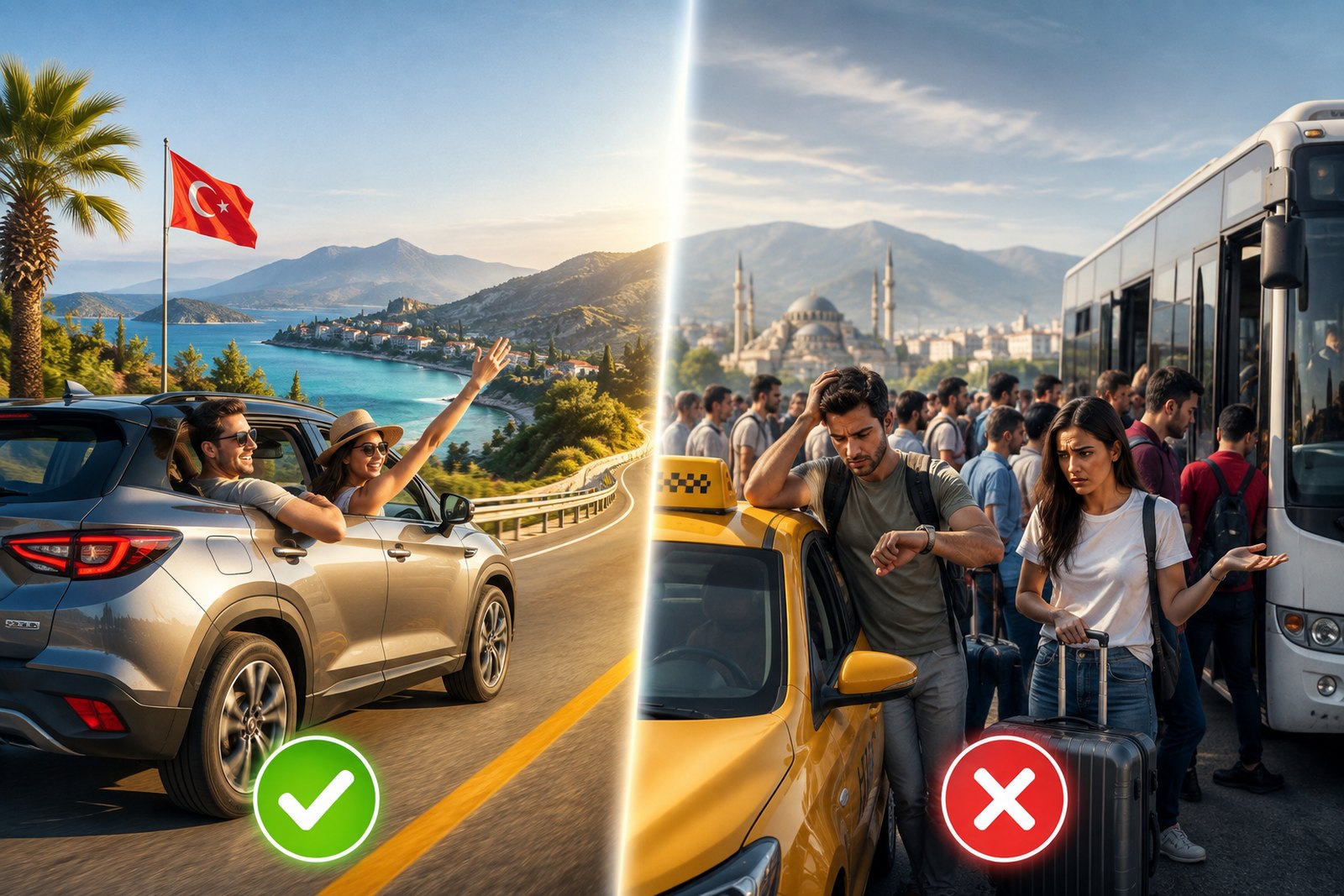
The question everybody asks the wrong way
"Is it worth renting a car in Turkey, or should we just take taxis?" is the single most common question we get, and almost nobody asks it in a form that can be answered. A car is not cheaper or more expensive than a taxi in the abstract. It is cheaper or more expensive for a specific number of people, a specific number of days, and a specific number of times you intend to leave the hotel.
The mistake is comparing the wrong things. People compare a rental quote — a single visible number, sitting there on the booking page for a whole week — against a taxi ride, which is a small number paid many times and never added up. €140 for seven days looks like a lot. Six taxi rides at €22 each looks like nothing. They are the same money.
So here is the arithmetic, done properly. Every price below is real and current, and we say where each one comes from. Where a number varies, we give the range instead of pretending it doesn't.
The numbers this article is built on
Four price sources drive everything that follows. Rental rates come from our own live inventory snapshot taken on 28 August 2026 — not a marketing "from" price, but the cheapest actually bookable car in each city on that date. Fuel is the Turkish pump price in the same period. The taxi tariff is the published Antalya rate. Bus fares are current operator prices on the routes named.
Conversions use roughly ₺56 to the euro, the September 2026 cross rate. Lira prices move with inflation faster than euro prices do, which is exactly why we quote the lira figure alongside — in six months the lira number will have drifted and the euro number will be close to unchanged.
| What | Price | In euro | Source |
|---|---|---|---|
| Rental, Antalya, manual | from €20 / day | €20 | our inventory, 28 Aug 2026 |
| Rental, Antalya, automatic | from €25 / day | €25 | our inventory |
| Rental, İstanbul | from €34 / day | €34 | our inventory |
| Petrol (benzin) | ₺71.41 / litre | €1.28 | pump price, Aug 2026 |
| Diesel (motorin) | ₺79.56 / litre | €1.42 | pump price, Aug 2026 |
| Taxi, flagfall | ₺35 | €0.63 | Antalya tariff 2026 |
| Taxi, per km | ₺40 | €0.71 | Antalya tariff 2026 |
| Taxi, minimum fare | ₺130 | €2.30 | Antalya tariff 2026 |
| Airport transfer AYT → Side / Belek | €35–40 per car | €40 | transfer operators |
| Bus, Antalya → Konya | ₺400 | €7 | operator price |
| Bus, İstanbul → Cappadocia | ₺1,150–1,400 | €21–25 | operator price |
What 100 kilometres actually costs you in fuel
This is the number that decides most of the argument, and it is smaller than people expect. A Fiat Egea or a Citroën C-Elysée — the two cars you are most likely to end up with in the €20–24 bracket in Antalya — burns about 6.5 litres per 100 km on the mixed roads you will actually drive: motorway to the ruins, coastal two-lane back to the hotel.
At ₺71.41 a litre that is ₺464 per 100 km, or about €8.30. Say €8–9 to keep it honest, because air conditioning in July is not free and coastal climbs cost you a litre or so.
Hold that number next to the taxi tariff: ₺40 per kilometre means 100 km of taxi is ₺4,000, roughly €71. Driving the same 100 km yourself costs €8.30 in fuel. The taxi is eight and a half times the marginal cost of the car — and that is before the taxi's flagfall, before waiting time while you look at a ruin, and before the ride home.
That ratio, not the daily rental rate, is why the car wins whenever you actually go anywhere.
Scenario 1: a beach week in Side, family of four
Seven nights in a hotel between Side and Belek. Two adults, two children. You fly into Antalya. You plan the usual: the Aspendos theatre, a day at Manavgat waterfall and market, one dinner in Side old town, and one longer day out to Perge and Kurşunlu.
Without a car, every one of those is a negotiation with a driver. Resort-area taxis rarely run the meter for tourists on excursion-shaped trips; they quote a round-trip price with waiting time included, which is honest enough but priced accordingly.
| Without a car | Cost | With a car | Cost |
|---|---|---|---|
| Airport transfer, both ways | €80 | Rental, 7 days, manual | €140 |
| Aspendos, taxi + waiting | €55 | Fuel, ~600 km | €50 |
| Manavgat, taxi + waiting | €50 | Parking + tolls allowance | €15 |
| Perge + Kurşunlu day | €60 | — | — |
| Local rides, dolmuş | €20 | — | — |
| Total | €265 | Total | €205 |
The car comes out €60 cheaper — and that is the boring part of the result. The interesting part is what the €205 buys that the €265 does not.
With a car, the marginal cost of the fifth trip is a couple of euros of fuel. Without one, it is another €50 conversation. That asymmetry changes behaviour: families with a car go to three or four more places than they planned, families without one quietly drop the second half of the list and spend the week at the pool. If you came to Turkey to see Turkey, this is the whole argument in one line.
Two honest caveats. If you take an automatic rather than a manual — and many people should, in Turkish summer traffic — add €35 for the week, and the gap narrows to €25. And if your genuine plan is the pool, the beach, and one dinner in town, then the transfer plus two taxis costs about €120 and the car is simply the wrong purchase. Nobody needs a car to lie down.
Scenario 2: ten days, Antalya → Pamukkale → Cappadocia → back
This is the trip where the comparison stops being close. Roughly 1,500 km over ten days, three bases, and a lot of things worth stopping for in between that no bus schedule acknowledges.
By bus, the route is entirely doable — Turkish intercity coaches are genuinely good, and we say so at length further down. Antalya to Denizli for Pamukkale, Denizli across to Nevşehir for Cappadocia, then the long leg back. Add the fact that bus stations sit outside town centres nearly everywhere, so each arrival ends with a taxi or a servis shuttle.
| Two travellers | By bus | By car |
|---|---|---|
| Antalya → Denizli | ₺1,200 (€21) | included below |
| Denizli → Nevşehir | ₺1,800 (€32) | included below |
| Nevşehir → Antalya | ₺2,200 (€39) | included below |
| Transfers from bus stations | €35 | — |
| Getting around Cappadocia | €90 (tours / taxis) | fuel only |
| Getting to Pamukkale travertines | €18 | fuel only |
| Rental, 10 days | — | €200 |
| Fuel, ~1,500 km | — | €125 |
| Tolls, parking | — | €20 |
| Total for two | €235 | €345 |
| Total for four | €425 | €345 |
Read that table carefully, because it contains the actual rule. For two people, the bus is cheaper — €235 against €345. For four people, the car is cheaper — €345 against €425 — because the car costs the same whether one person or four sit in it, and the bus charges every seat.
The break-even is somewhere between three and four travellers. Below it, buses win on money. Above it, the car wins on money and on everything else.
And "everything else" is not a small thing on this particular route. The Antalya–Pamukkale road passes the Kibyra ruins and the Salda lake, neither of which has a bus. The stretch into Cappadocia crosses the Konya plain, where the thirteenth-century caravanserais sit directly on the road, twenty minutes apart, and are free to walk into. A bus passes all of them at 90 km/h.
Scenario 3: four days in İstanbul — where the car loses
We would rather say this ourselves than have you discover it: renting a car for a city break in İstanbul is a bad idea, and we do not recommend it.
The rates alone are worse — İstanbul starts at €34 a day against Antalya's €20, because the fleet there serves business travel, not beach holidays. But the rate is not the problem. The problem is that a car in İstanbul is a liability you pay to carry around.
Hotel parking in Sultanahmet or Beyoğlu runs €10–18 a night where it exists at all. Street parking in the centre is metered, scarce, and enforced. The bridges and the tunnel carry tolls. Traffic between 08:00 and 20:00 turns a four-kilometre hop into forty minutes. Meanwhile the tram, the metro and the ferries reach essentially everything a visitor wants, cost small change per ride with an İstanbulkart, and the ferry across the Bosphorus is one of the better things you can do in the city for the price of a bus ticket.
Four days in İstanbul: about €25 per person on public transport, or roughly €190 for a car you will spend the week trying to park. The maths is not close, and no amount of loyalty to car rental changes it.
The right move is the hybrid: see İstanbul on foot and on the tram, then pick the car up on the day you leave the city — from an airport desk, not a downtown office — and drive out to the parts of the country where a car earns its keep.
Find a car
Prices and availability from local companies — instantly, no enquiries
The break-even rules, in plain language
Strip out the scenarios and four rules survive. They will answer the question for almost any trip without a spreadsheet.
- Three or more travellers: the car is almost always cheaper, because it charges by vehicle and everything else charges by head.
- Two or more day trips in a week: the car pays for itself on the second excursion, and everything after that is nearly free.
- Staying inside one city: skip the car. This is true in İstanbul, mostly true in İzmir, and true in Antalya's old town if you never leave it.
- Three or more towns on the route: take the car even if you are two people. The bus fares alone approach the rental, and then the transfers on both ends add up on top.
The costs people forget — on both sides
Every comparison you find online forgets something, usually in whichever direction the author already prefers. Here is the full list of the things that actually move the number, in both columns.
On the rental side
The deposit is the one that surprises people, and it is not a cost — it is a hold. A supplier blocks €200–500 on the card and releases it after you return the car. It does not leave your account permanently, but it does occupy your credit limit for the trip, which matters if that card is also paying for the hotel.
Worth knowing: a good part of the Turkish fleet is deposit-free. In our Antalya inventory, several of the cheapest cars — the Fiat Egea and the Citroën C-Elysée among them — carry a zero deposit. If your card is tight, filter for those rather than assuming a hold is unavoidable.
One-way fees apply if you collect in Antalya and drop in İzmir; they are typically €40–80 within Turkey and are quoted before you book, so there are no surprises. A second driver is usually free or a few euros a day. Drivers under 25 sometimes pay a young-driver surcharge. Parking in resort towns is either free at the hotel or €2–4 a day in a municipal lot.
On the taxi and bus side
Waiting time is the invisible one. A meter charges for standing still, so a taxi that takes you to Aspendos and waits two hours while you walk the theatre is not charging you for 40 km — it is charging for 40 km plus two hours of a driver's day. This is why excursion trips get quoted as fixed prices, and why those prices look high next to the distance.
Bus stations sit outside town in most Turkish cities. The fare gets you to the otogar; a taxi or the free servis shuttle gets you the rest of the way. Budget €5–15 per arrival and check whether your operator runs a servis to the centre, because many do and it is included.
Luggage, for a family, is the quiet dealbreaker. Two adults, two children, four suitcases and a pushchair do not fit in a standard taxi, so you are booking a van at van prices — or making two trips.
The resort taxi trap, and how to not fall into it
The Antalya tariff is public and reasonable: ₺35 to start, ₺40 per kilometre, ₺130 minimum. A metered ride is fair value, and most drivers are straight with you.
The trap is not dishonesty, it is the fixed-price habit in resort areas. Outside hotel gates, for tourist-shaped journeys, the meter often stays off and a number gets quoted instead. Sometimes it is fair. Sometimes it is triple.
The defence takes ten seconds: know the distance before you get in. Your hotel to Side old town is 8 km, which is ₺355 on the meter — about €6.30. If the quote is €20, you now know exactly how to answer. Ask for the meter ("taksimetre, lütfen"), and if the answer is no, the next taxi is thirty seconds away.
This is also, quietly, one of the strongest arguments for the car. Not the money — the fact that you never have that conversation at all, in a language you do not speak, at eleven at night, with tired children.
In defence of the Turkish bus — it is genuinely excellent
It would be easy for a car rental company to write this article as a hit piece on buses. That would also be wrong, and anyone who has actually taken one knows it.
Turkish intercity coaches are among the best in the world at the price. Three-across seating on the good operators, an attendant serving tea and cake, wifi, a screen, and a rest stop every three hours whether you wanted one or not. A ₺400 fare from Antalya to Konya — about €7 — for four hours of that is remarkable value by any standard.
The night buses deserve a specific mention. İstanbul to Cappadocia overnight, ₺1,150–1,400, saves you a hotel night and a domestic flight that in peak season runs ₺8,000–10,000. As a way of covering a long, dull distance while unconscious, it is hard to beat, and no rental car competes with it.
Where the bus genuinely wins: solo travellers, two travellers on long point-to-point legs, anyone crossing the country once rather than exploring a region, and anyone who does not want to drive. That last one is not a small category and there is nothing wrong with being in it.
Dolmuş: the option nobody puts in the comparison
Between the taxi and the intercity coach sits the dolmuş — a shared minibus that runs a fixed route, leaves when it fills, and stops wherever you say "inecek var". Fares are a fraction of a taxi, they run constantly along the coastal strips, and for short hops between neighbouring resort towns they are the correct answer.
Side to Manavgat, Kemer to Beldibi, Ölüdeniz to Fethiye — these are dolmuş journeys, not taxi journeys, and paying taxi prices for them is a rookie error. The limitation is obvious: they run where the route runs, on the coastal road, and the ruins in the hills are not on it.
In practice the sensible traveller uses all three. Dolmuş for the town next door, a car for the days that leave the coast, and a bus for the one long leg across the country.
Tolls and the HGS question
Turkish motorways are tolled electronically. There are no cash booths left; the system reads a windscreen tag as you pass. Every rental car in Turkey comes with an HGS tag already fitted, and the supplier settles the balance afterwards — you do not buy anything, top anything up, or stop anywhere.
The amounts are modest for a holiday-shaped route. The Antalya region is served largely by toll-free dual carriageway; you meet real tolls on the long motorway legs inland and around İstanbul. Budget €10–20 of tolls for a two-week trip that includes a couple of long motorway days, and you will most likely come in under it.
One thing to keep straight: this applies to rental cars on Turkish plates. Bringing your own foreign-plated car is a different regime with its own paperwork, and since 2026 unpaid tolls are checked at the border on exit.
The line item this comparison usually hides: insurance
Most car-versus-taxi articles quietly leave insurance out, which is convenient because it is the one cost that can move the rental column by fifty euros. We would rather put it in.
Every Turkish rental includes basic third-party cover by law, and nearly every one includes a collision waiver with an excess — meaning damage to your own car is covered above a deductible you carry, usually somewhere between €300 and €800. That excess is the real exposure, and reducing it to zero is an optional extra sold at the desk for roughly €7–12 a day.
On a seven-day rental that is €50–85, which would change Scenario 1 from a €60 win into a rough draw. So decide deliberately rather than at the counter at midnight: if your travel insurance or credit card already covers rental excess — many do, and people forget — you are paying twice for the same protection. If it does not, and the thought of an €800 bill for a car-park scrape would ruin the holiday, buy it and consider it the price of sleeping well.
The taxi and bus column has no equivalent line, and that is a genuine point in its favour. Someone else carries the risk, and it is included in the fare.
When you should not drive in Turkey, whatever the arithmetic says
Money is not the only input, and we would rather you enjoy the trip than win a spreadsheet.
Turkish driving is assertive rather than dangerous — lane discipline is loose, overtaking is enthusiastic, and city traffic rewards decisiveness. Drivers who are comfortable in Italy or Greece adapt within an hour. Drivers who find a busy roundabout at home stressful will not have a relaxing week, and no saving justifies that.
Two specifics worth knowing before you decide. Coastal mountain roads — the D400 towards Kaş, the climb behind Kemer — are beautiful and demanding, with long descents and blind bends. And parking in the old towns of Antalya, Side and Kaş is genuinely scarce in high season; the correct move is a lot on the edge and a ten-minute walk, not a hopeful loop of the centre.
If either of those describes something you would rather avoid, the honest recommendation is the hybrid: buses or a driver for the long legs, a car for two or three specific days when you want the hills to yourself.
How to keep the rental side of the comparison cheap
Every number in this article assumed the cheap end of the market, and that is not luck — it is the result of four decisions anyone can make.
- Book three to five days ahead rather than on arrival. The €20 Antalya cars are the first to go; the walk-up rate in August is a different market.
- Take the manual if you can drive one. It is €5 a day cheaper, which is €35 on a week — precisely the amount that decided Scenario 1.
- Filter for zero-deposit cars if your card is doing other work on the trip. They exist in quantity in Turkey and cost no more.
- Collect at the airport, not in the city. Airport desks have the deepest fleets, and you skip the transfer fare on both ends — which is €80 of Scenario 1 gone before you start.
So what is the answer?
For a family of three or more who intend to leave the hotel: the car, clearly, on money and on everything else.
For two people doing one long point-to-point leg: the bus, and it is not close.
For a city break in İstanbul: public transport, and we will happily talk you out of the car.
For the very common case — two adults, one week on the coast, three or four days out — it lands within about €30 either way, and the decision comes down to something other than money: whether you would rather negotiate with drivers or park the thing yourself.
The number that should stay with you is the one from the fuel section. Driving 100 km costs €8.30. Taking a taxi 100 km costs €71. Once the car is on the drive, seeing more of Turkey is nearly free — and that, far more than the daily rate, is what you are actually buying.
Frequently asked questions
Is it cheaper to rent a car or take taxis in Antalya?+
For a week with two or more day trips, the car is cheaper. A seven-day manual rental starts at €140, and 600 km of driving costs about €50 in fuel. The same excursions by taxi run €165–200 because resort taxis quote fixed prices that include waiting time. If you plan to stay at the hotel and go out once, taxis win.
How much does fuel cost in Turkey in 2026?+
Petrol is about ₺71.41 a litre and diesel about ₺79.56, which is roughly €1.28 and €1.42. A typical rental car uses 6.5 litres per 100 km, so 100 kilometres costs around €8.30 in petrol.
What is the taxi tariff in Antalya?+
The 2026 published tariff is ₺35 to start, ₺40 per kilometre and a ₺130 minimum fare, with the same rate day and night. That works out at about €0.71 per kilometre. Ask for the meter — in resort areas drivers often quote a fixed price instead.
Are Turkish intercity buses good?+
They are excellent and genuinely cheap: Antalya to Konya is about ₺400 for a four-hour ride with three-across seating, tea service and wifi. Buses beat a car for solo and two-person point-to-point travel. They lose when you want to stop at things between cities, or when you are four people paying four fares.
Should I rent a car in İstanbul?+
No, not for the city itself. Rates start at €34 a day, hotel parking runs €10–18 a night, and traffic makes short journeys long. The tram, metro and ferries reach everything for small change. Pick the car up on the day you leave the city instead, preferably at the airport.
Do I need to buy an HGS toll tag for a rental car?+
No. Every rental car in Turkey already has the tag fitted and the supplier settles the tolls afterwards. You never stop at a booth or top anything up. Budget €10–20 of tolls for a two-week trip with a few long motorway days.
How big a deposit will the rental company hold?+
Typically €200–500, blocked on your card and released after you return the car. A significant part of the Turkish fleet is deposit-free, including some of the cheapest cars in Antalya, so filter for those if your credit limit is doing other work on the trip.
What about the dolmuş — is it worth using?+
Yes, for short hops between neighbouring coastal towns. A dolmuş costs a fraction of a taxi, runs constantly along the coast road, and stops on request. It does not help you reach ruins and lakes inland, which is exactly where a car earns its money.
Tip from RentoRika
Book your car in advance — at least 3–5 days before the trip. In high season (June–September) popular models sell out fast.
Related articles
Ready to go?
Pick a car for your dates — in a couple of minutes.